Water puts out ordinary fires. Powder makes a mess and coats everything it touches. Foam sits in between - it smothers a burning liquid surface, stops it re-igniting, and does it without the visibility-killing cloud a powder extinguisher throws up. That's exactly why AFFF foam extinguishers are the standard choice wherever flammable liquids are a real risk: kitchens, workshops, warehouses, marine vessels, and fuel storage areas across the UAE. This guide covers the real types sold here, verified specs from four actual supplier catalogues, and what actually separates a compliant extinguisher from a generic one.
Water alone can actually spread a burning flammable liquid rather than stop it, since the liquid can float on top of the water and keep burning. AFFF (Aqueous Film-Forming Foam) solves that problem by spreading a thin aqueous film across the liquid surface, sealing off the vapors that feed the flame and stopping it re-igniting after the initial knockdown. That's the core reason foam extinguishers are specified anywhere flammable liquids are handled or stored, rather than relying on water or powder alone.
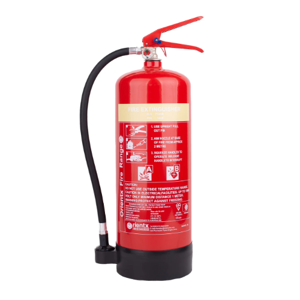
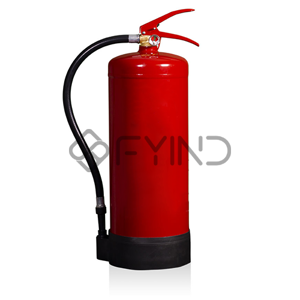
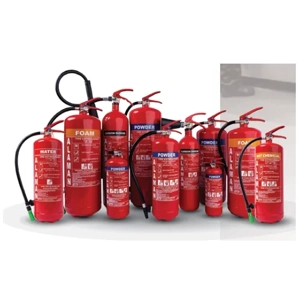
A hand-carried cylinder, commonly 2L to 9L, mounted on a wall bracket for grab-and-go use - the standard configuration for offices, retail units, kitchens, and vehicles across the UAE.
A wheeled, much larger-capacity unit - 25L, 50L, 100L and above - used where a bigger fire risk needs significantly more foam volume than a portable cylinder can deliver, such as warehouses, workshops, fuel storage areas, and industrial facilities.
A foam extinguisher specifically certified to marine standards (MED certification), required on vessels and offshore facilities where a standard land-use certification isn't sufficient for regulatory sign-off.
Office, retail unit, or small kitchen? A portable 2L–9L unit mounted at a standard access point. Warehouse, workshop, or fuel storage area with a genuinely bigger liquid fire risk? A trolley/mobile unit sized to that risk, not a portable stretched beyond its coverage. Working on a vessel or offshore facility? A marine-approved, MED-certified extinguisher specifically - a standard land-certified unit won't satisfy marine regulatory requirements.
Foam fire extinguishers are primarily selected wherever flammable liquids are stored, handled or transferred. Since AFFF foam forms a protective blanket over burning fuel, it is widely used in commercial, industrial and marine environments where water alone cannot safely control Class B fires. In addition to liquid fires, these extinguishers are also suitable for ordinary combustible materials such as paper, wood and textiles, making them a practical choice for mixed-risk workplaces across the UAE.
| Location | Why Foam is Recommended |
|---|---|
| Petrol Stations & Fuel Storage Areas | Rapidly suppresses petrol, diesel and other flammable liquid fires by sealing vapours. |
| Warehouses | Protects areas storing fuels, paints, solvents and packaging materials. |
| Vehicle Workshops & Garages | Suitable where fuel spills, lubricants and engine fires present Class B fire risks. |
| Manufacturing Plants | Common in chemical processing, coating and industrial production facilities. |
| Marine Vessels & Offshore Platforms | MED-approved foam extinguishers are widely specified for shipboard fire protection. |
| Airports & Logistics Facilities | Suitable for areas handling aviation fuel, loading bays and hazardous liquids. |
| Commercial Buildings | Used in boiler rooms, generator rooms and maintenance workshops where liquid fuel hazards exist. |
Although foam fire extinguishers are highly effective for Class A and Class B fires, they are not suitable for every fire type. Using the wrong extinguisher can increase the danger, damage equipment or place the operator at greater risk. Before selecting a foam extinguisher, always identify the fire class and confirm that the extinguisher matches the hazard.
| Situation | Can Foam Be Used? | Recommended Extinguisher |
|---|---|---|
| Live Electrical Equipment | No | CO₂ Fire Extinguisher |
| Cooking Oil & Deep Fat Fryers (Class F) | No | Wet Chemical Fire Extinguisher |
| Lithium Battery Fires | No | Specialist Lithium Battery Fire Extinguisher |
| Combustible Metal Fires (Magnesium, Sodium, Aluminium Powder) | No | Class D Metal Fire Extinguisher |
| High Voltage Electrical Rooms | No | CO₂ or Clean Agent Fire Extinguisher |
Foam fire extinguishers are designed primarily for Class A (wood, paper, textiles) and Class B (petrol, diesel, paints and other flammable liquids) fires. If you are unsure about the fire type, evacuate the area immediately and contact emergency services rather than attempting to fight the fire with the wrong extinguisher.
Fire extinguishers are selected according to the type of fire they are designed to control. Foam fire extinguishers are highly effective against ordinary combustible materials and flammable liquid fires, but they are not suitable for every fire class. Understanding these classifications helps you choose the correct extinguisher and improves workplace fire safety.
| Fire Class | Typical Materials | Foam Suitable? | Recommended Extinguisher |
|---|---|---|---|
| Class A | Wood, paper, cardboard, textiles, rubber | Yes | Foam Fire Extinguisher |
| Class B | Petrol, diesel, paints, solvents, fuels | Yes | Foam Fire Extinguisher |
| Class C | Flammable gases such as LPG, propane and butane | No | Dry Powder Fire Extinguisher |
| Class D | Magnesium, sodium, aluminium powder and combustible metals | No | Class D Metal Fire Extinguisher |
| Class F | Cooking oils, animal fats and vegetable oils | No | Wet Chemical Fire Extinguisher |
| Electrical Equipment | Live electrical panels, switchboards, servers and machinery | No | CO₂ Fire Extinguisher |
Foam fire extinguishers are best suited for environments where both Class A and Class B fire risks exist, such as warehouses, vehicle workshops, fuel storage facilities, commercial buildings and industrial sites. If electrical equipment or specialised hazards are present, additional extinguisher types should be installed alongside foam extinguishers as part of a complete fire protection strategy.
Every fire extinguisher is designed for specific fire hazards. While foam extinguishers are excellent for ordinary combustibles and flammable liquids, other extinguisher types may be better suited for electrical equipment, cooking oils or gas fires. Understanding these differences helps businesses choose the right combination of extinguishers instead of relying on a single type for every situation.
| Extinguisher Type | Best Used For | Avoid Using On | Typical Applications |
|---|---|---|---|
| Foam (AFFF) | Class A and Class B fires including petrol, diesel, paints, solvents and paper. | Live electrical equipment, cooking oil fires and combustible metals. | Warehouses, workshops, garages, fuel storage areas and industrial facilities. |
| Water | Class A fires involving wood, paper, textiles and cardboard. | Flammable liquids, electrical equipment and cooking oil fires. | Schools, offices, retail stores and commercial buildings. |
| CO₂ | Electrical fires involving switchboards, servers, control panels and IT equipment. | Deep-seated Class A fires where re-ignition is possible. | Server rooms, electrical substations, laboratories and offices. |
| Dry Powder (ABC) | Class A, B and C fires including gases and mixed industrial hazards. | Enclosed indoor spaces where powder contamination may damage equipment or reduce visibility. | Construction sites, factories, fuel stations and outdoor industrial environments. |
| Wet Chemical | Class F fires involving cooking oils and deep-fat fryers. | Gas fires, combustible metals and large fuel storage fires. | Commercial kitchens, restaurants, hotels and food processing facilities. |
Many commercial buildings in the UAE use more than one type of fire extinguisher rather than relying on a single unit. For example, a warehouse may install foam extinguishers near fuel storage areas, CO₂ extinguishers in electrical rooms, and dry powder extinguishers in outdoor operational areas. Selecting the correct extinguisher should always be based on the site's fire risk assessment and applicable fire safety requirements.
| Specification | What to Look For |
|---|---|
| Capacity | UAE stock runs from 2L portable units up to 100L trolley units - size to the actual risk, not a generic "bigger is safer" assumption |
| AFFF Concentration | Commonly 3%, 5%, 6%, or 15% depending on the specific formulation and manufacturer - this affects mixing ratio and performance, not just a marketing number |
| Fire Rating | Look for the specific A and B class ratings (e.g. 27A 233B) rather than a general "multi-purpose" claim - this tells you the actual tested extinguishing capability |
| Discharge Time | Commonly stated in seconds on verified listings (e.g. 76 sec) - a longer discharge time gives more working time on a stubborn fire |
| Certification | EN3 is the standard European baseline; Kitemark (BSI), DNV, and MED certifications add specific recognized third-party testing on top of it - ask which ones your specific project or authority requires |
Foam extinguishers stored in un-shaded outdoor locations or vehicles left in direct UAE summer heat can see internal pressure rise faster than in milder climates. Confirm the extinguisher's rated operating temperature range covers your actual storage conditions, and prioritise shaded or indoor mounting wherever the location allows it.
The UAE market offers foam fire extinguishers from several recognised manufacturers and fire safety brands. While specifications, certifications and capacities vary by model, choosing products from established brands makes it easier to source replacement parts, maintenance support and certified equipment for commercial and industrial projects.
| Brand | Known For | Available From (FYIND Suppliers) | Typical Applications |
|---|---|---|---|
| Bristol | Portable and trolley foam fire extinguishers with recognised fire ratings. | Fire Supplies | Commercial buildings, warehouses and industrial facilities. |
| Flametech | Industrial foam extinguishers including high-capacity trolley units. | Fire Supplies | Fuel storage, factories and logistics operations. |
| Fomtec | AFFF foam formulations used in certified fire protection equipment. | MAF Fire Middle East LLC | Commercial and industrial fire protection systems. |
| Lalizas | Marine-approved foam fire extinguishers for vessels and offshore applications. | Fire Supplies | Ships, boats, offshore platforms and marine facilities. |
| Megasafety | Portable and trolley extinguishers for commercial and industrial environments. | Fire Supplies | Factories, warehouses and construction projects. |
| INILAM | EN3-certified foam fire extinguishers with multiple AFFF concentrations. | MAF Fire Middle East LLC | Commercial buildings and industrial fire protection. |
Brand alone should not determine your purchase. Always compare the extinguisher's capacity, fire rating, AFFF concentration, certification (such as EN3, DNV or MED), warranty and after-sales servicing before selecting a supplier.
Suppliers in Dubai with real listed specifications pulled from verified catalogues.
Maf Fire Middle East publishes 15 foam fire extinguisher listings covering a genuinely broad certification spread - EN3, Kitemark (BSI), DNV, and MED-certified marine units - across multiple AFFF concentrations and capacities, making them a strong single source when a project needs a specific certification confirmed rather than a general compliance claim.
Al Aman manufactures its own foam extinguisher range rather than trading third-party stock, covering both portable and mobile/trolley configurations - manufactures both portable and mobile foam fire extinguishers in-house, making them a suitable choice for contractors looking for factory-produced extinguishers instead of imported trading stock.
Why contractors choose them: a manufacturer producing both portable and mobile units in-house typically offers more consistent build quality and better bulk pricing for large repeat orders than a general trader.
Fire Supplies carries the largest foam extinguisher range on this page by product count, spanning multiple recognized brands - Flametech, Bristol, Lalizas, Megasafety - across portable, trolley, and marine-approved configurations, giving genuine brand choice rather than a single-line catalogue.
Universal Fire Fighting System and Services supplies portable and trolley foam fire extinguishers while also providing fire protection system installation, commissioning, annual inspection, preventive maintenance, AMC (Annual Maintenance Contract) support and extinguisher refilling services. This makes them a practical choice for businesses looking to source equipment and manage ongoing fire safety compliance through a single service provider.
Why contractors choose them: Combining foam extinguisher supply with installation, commissioning, annual inspections, refilling and long-term maintenance contracts simplifies equipment management, reduces coordination between multiple vendors and helps businesses maintain compliance throughout the equipment lifecycle.
Contact hours, exact stock and current pricing vary by supplier - always confirm capacity, AFFF percentage, fire rating, and certification for the specific batch you're buying before placing an order.
A small portable unit installed where a genuinely bigger liquid fire risk exists (large workshop, fuel storage) won't deliver enough foam volume to knock the fire down. Fix: size the extinguisher (or step up to a trolley unit) based on the actual risk assessment for that space, not a generic minimum.
Extinguishers stored in direct UAE summer heat or unshaded vehicles can see pressure gauge readings drift outside the normal range faster than expected. Fix: check the pressure gauge during routine inspections specifically for units in hot storage locations, and prioritise shaded or indoor mounting wherever possible.
Installing a standard land-certified extinguisher where a marine (MED) certification is actually required leaves a project non-compliant even if the physical extinguisher itself works fine. Fix: confirm the specific certification required for your application (EN3, Kitemark, DNV, or MED) before ordering, not just a general "certified" description.
Foam extinguishers need periodic pressure testing and refilling, and a missed service date is one of the most common compliance failures found on inspection. Fix: track service due dates against each extinguisher's tag or log, and consider a supplier that also handles servicing to reduce the coordination overhead.
Regular inspection and maintenance help ensure a foam fire extinguisher operates correctly during an emergency. In commercial and industrial facilities across the UAE, extinguishers should be visually checked on a routine basis and professionally serviced according to the manufacturer's recommendations and applicable fire safety regulations. Proper maintenance also helps identify pressure loss, corrosion, physical damage and expired extinguishing agents before they become safety risks.
| Maintenance Task | Recommended Frequency | What to Check |
|---|---|---|
| Visual Inspection | Monthly | Pressure gauge, safety pin, tamper seal, hose, nozzle and physical damage. |
| Professional Service | Annually | Complete operational inspection, component checks and service tagging. |
| Refilling | Immediately after any discharge | Recharge the extinguisher even if only partially used. |
| Hydrostatic Pressure Test | As specified by the manufacturer or applicable standards | Verify cylinder integrity and safe operating pressure. |
| Replacement | When damaged, expired or beyond economical repair | Replace extinguishers showing corrosion, leakage or failed pressure tests. |
A foam fire extinguisher should never be returned to service after use without professional inspection and refilling. Businesses managing multiple extinguishers often benefit from working with suppliers that also provide annual inspections, maintenance contracts and refilling services, helping maintain compliance and reduce equipment downtime.
Indicative ranges by capacity - always request a written quote for your exact spec and certification.
| Extinguisher Type | Indicative Price (AED) |
|---|---|
| Portable 2L–6L | AED 60 – 180 |
| Portable 9L | AED 150 – 300 |
| Trolley/Mobile 25L | AED 350 – 600 |
| Trolley 100L+ | AED 700 – 1,500+ |
Indicative price ranges for reference only - actual quotes vary by brand, certification, order volume, and the specific supplier.
Building-wide compliance rollouts typically need extinguishers across multiple rooms and floors, so most orders in UAE are bulk by default. Specify exact capacity, AFFF percentage, and required certification up front so the supplier can quote an accurate bulk rate.
Foam extinguishers are rated for Class A fires (ordinary combustibles like wood and paper) and Class B fires (flammable liquids), making them a versatile choice for kitchens, workshops, and areas with both fire types present.
AFFF percentage refers to the concentration of foam concentrate in the mixing ratio with water - common figures on verified UAE stock include 3%, 5%, 6%, and 15%. Different manufacturers formulate to different percentages, so this isn't directly comparable across brands without checking the specific product.
Only if the extinguisher is going on a vessel or offshore facility subject to marine regulatory requirements. Standard EN3, Kitemark, or DNV certification covers land-based commercial and industrial use, but marine applications specifically require MED certification.
Portable units (2L-9L) suit standard offices, kitchens, and retail spaces. Trolley or mobile units (25L and up) are needed where the actual fire risk - larger liquid volumes, bigger equipment, industrial processes - exceeds what a portable unit can realistically handle.
Foam extinguishers generally need annual inspection and periodic pressure testing and refilling, in line with the manufacturer's service schedule and local civil defense requirements. Missed service dates are a common compliance failure, so tracking due dates per unit matters.
Marine vessels and offshore installations generally require MED-certified foam fire extinguishers that comply with marine safety regulations. These extinguishers are designed for shipboard environments and are commonly installed in engine rooms, machinery spaces, cargo areas and fuel storage locations. Always confirm the certification required by the vessel's classification society or applicable maritime authority before purchasing.
Yes. Foam fire extinguishers can generally be refilled after use, provided the cylinder remains in good condition and passes the required inspection. Refilling should only be carried out by qualified fire protection service providers using the correct extinguishing agent and replacement components specified by the manufacturer.
The service life of a foam fire extinguisher depends on the manufacturer, maintenance history and storage conditions. With regular inspections, professional servicing and timely pressure testing, many extinguishers remain in service for several years. Always follow the manufacturer's maintenance schedule and replace units that fail inspection, show corrosion or no longer meet safety requirements.
Modern foam extinguishing agents vary by formulation and manufacturer. Many newer products are designed with reduced environmental impact while still providing effective fire suppression. If environmental performance is important for your project, ask the supplier for product-specific environmental information, certifications and disposal recommendations before purchase.
Yes. Foam fire extinguishers are designed for Class B flammable liquid fires, including diesel, petrol, kerosene, paints and many industrial solvents. The foam forms a blanket over the burning liquid, helping suppress flames and reduce the risk of re-ignition. Always use an extinguisher with an appropriate fire rating for the size of the hazard.
There is no single size suitable for every warehouse. The appropriate extinguisher capacity depends on the building layout, fire risk assessment, the quantity of flammable liquids stored and applicable fire safety requirements. Portable foam extinguishers are commonly installed for general protection, while larger warehouses, fuel storage areas and industrial facilities may require trolley-mounted foam extinguishers to provide additional extinguishing capacity.
Comparing foam fire extinguisher suppliers in Dubai? Reach out directly to the suppliers listed above for current stock, certifications, and bulk pricing.

 0
0