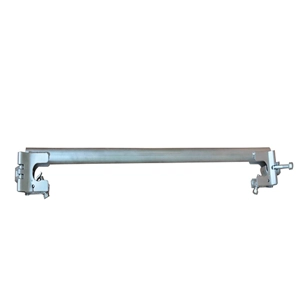
A transom is the short horizontal tube that runs across the scaffold bay, sitting on top of the ledgers and directly under the boards - it's what actually carries the deck. Get the length, spacing, or system fit wrong and boards either don't reach or flex more than they should underfoot. Below are the UAE suppliers and manufacturers publishing transom specifications, with real lengths, weights, and pricing data - across standard, adjustable, heavy-duty, aluminum, and galvanized steel options for Kwikstage, Cuplok (Cuplock), and Ringlock systems.
Quick check before you order: a transom is not the same as a scaffolding beam or a ledger. A ledger runs the length of the bay and ties standards together; a transom runs across the bay, sitting on the ledgers, directly supporting the boards. If you're spanning a large gap like a stairwell or loading bay, you want a beam, not a transom.
|
1.2 – 2.5 m
Common transom lengths |
5.5 – 9.6 kg
Typical transom weight |
25 tons/week
Bulk supply capability |
BS & EN
Common compliance standard |
Suppliers spanning Dubai, Ajman, and Jebel Ali, from a certified multi-length manufacturer to a large-scale bulk supplier quoting by the ton.
Phone: +971 4 885 5001 | Location: Nad Al Hammar, Dubai, UAE | Serves: Dubai, Abu Dhabi, Sharjah, RAK, Fujairah, Ajman, UAQ
Certificate: ISO 9001 | Business Type: Manufacturers, Suppliers
Ascend is the only supplier with a full length-and-weight breakdown for intermediate transoms - four distinct lengths from 1.2 m to 2.5 m, each with its own matched weight, and ISO 9001 certification behind the whole range. That level of detail makes it straightforward to pick the exact length for your bay width without guessing or rounding up. As a Dubai-based manufacturer established in 2006 with UAE-wide delivery, they're a strong first call for project-specific transom orders.
Phone: 050 278 4566 / 056 796 9013 | Location: Ajman Industrial 2, Ajman, UAE | Serves: UAE-wide
Al Dereya positions itself as a full-solution manufacturer and rental supplier covering steel fabrication, steel and aluminium scaffolding, and formwork - with stated experience across construction, oil and gas, mechanical, bridge, and high-rise scaffolding. That breadth is the appeal here: if your transom order is part of a bigger scaffold system purchase or rental for an industrial or high-rise project, Al Dereya can likely bundle it with the rest of the rig rather than sourcing transoms separately.
Phone: +971 4 880 6686 | Brand: SinoPro (sinopro.ae) | Location: Jebel Ali Free Zone, Dubai, UAE
SinoPro publishes hard bulk-supply numbers most suppliers don't - 25 tons/week capacity, 1-week lead time, ex-UAE-warehouse terms, and a per-ton reference price. That combination is aimed squarely at large-volume buyers (major contractors, bulk procurement) rather than someone needing a handful of transoms for one rig. Their scale, backed by the China National Building Material Group Corporation parent, makes them worth a call specifically when the order is measured in tons rather than pieces.
Picture a scaffold bay from above: the standards are the four corner posts, the ledgers run along the length of the bay connecting standards to standards, and the transoms run across the bay, resting on top of the ledgers. The boards sit directly on the transoms. So a ledger holds the frame together lengthwise; a transom is what the platform actually rests on.
Why does the "intermediate" in "intermediate transom" matter? A main transom sits directly at the standard, taking the full structural load down into the frame. An intermediate transom sits between the main transoms, adding extra board support across a wider bay without carrying the same primary structural role - it stops the boards from sagging over a longer span rather than bearing the main load path.
"Transom" isn't a single spec - it splits by system compatibility, material, and adjustability. Here's what's actually on offer across UAE suppliers.
The question this answers: "Which transom actually carries the main structural load down into the frame?" The main transom, fitted directly at the standard, at every bay junction, without exception. It's the load path that ties the deck back into the vertical frame, which is why it's never skipped even on the simplest rig.
Best for: Every scaffold bay, at every standard - this is the non-negotiable structural transom, not an optional add-on.
The question this answers: "The boards are sagging in the middle of a wide bay - do I need thicker boards, or is there a fitting for this?" An intermediate transom, placed between the main transoms, gives the boards a mid-span support point so they don't flex as much underfoot. It's the type Ascend publishes in four lengths (1.2/1.3/1.8/2.5 m) with matched weights - see the supplier section above for the full spec.
Best for: Wider bays where board deflection underfoot is a concern. Not a substitute for the main transom - it's an addition, not a replacement.
The question this answers: "One end of my scaffold is right against a masonry wall - do I still need a standard at that end?" Not necessarily. A putlog is a transom-like tube with a flattened end that rests directly in a mortar joint or on brickwork, removing the need for a second row of standards on a putlog (bricklayer's) scaffold. It's a different structural approach from a fully independent scaffold, and it's worth confirming with a structural engineer that the wall can actually take that bearing load before specifying putlogs.
Best for: Bricklaying and masonry-facing scaffolding where one side can bear directly on the wall. Confirm wall bearing capacity before use - this isn't a fit for every facade.
The question this answers: "I need a ladder access hatch through this platform level - does that change the transom layout?" Yes. A ladder access transom (or ladder trap transom) frames the opening left for a ladder to pass through the deck, positioned to support the boards around the hatch edge while leaving the access gap clear. Getting this positioning wrong either blocks the ladder or leaves an unsupported board edge right next to the opening.
Best for: Any scaffold level with a ladder access hatch through the deck. Plan the hatch position before ordering transoms, since it dictates the layout at that bay.
The question this answers: "I'm running a Kwikstage or Cuplok rig - what transom fits?" A standard transom, built in galvanized steel to interlock directly with the standards and ledgers on frame and modular scaffolding. This is the default cross beam on the vast majority of UAE construction sites, whether the rig is Kwikstage, Cuplok, or traditional tube-and-coupler.
Best for: General construction platforms on Kwikstage, Cuplok, or tube-and-coupler scaffolding. See Ascend Access Systems Scaffolding LLC's four-length intermediate transom range above.
The question this answers: "My system uses a rosette joint, not a cup or a wedge clip - does a standard transom fit?" No - Ringlock transoms are built with a wedge-lock end fitting engineered specifically for the rosette collar, letting a single hammer blow lock the transom in place rather than a bolted or clipped connection. That's a different mechanical fit from a Kwikstage or Cuplok transom end.
Best for: High-rise and heavy-duty modular scaffolding running a genuine Ringlock system. Confirm the wedge-lock fitting matches your rosette spacing before ordering.
The question this answers: "My bay widths aren't consistent across the site - do I need a different fixed-length transom for every gap?" Not necessarily. An adjustable transom extends or retracts within a range, letting one component cover several bay widths on uneven terrain or irregular structures, rather than stocking multiple fixed lengths.
Best for: Irregular structures, uneven terrain, industrial maintenance work where bay widths vary. Confirm the extension range covers your actual widest and narrowest bays before ordering.
The question this answers: "Do I need galvanized steel, or will aluminum do?" Heavy-duty galvanized steel transoms are the default for industrial maintenance, refinery work, and high-load platforms where corrosion resistance and load capacity matter most. Aluminum transoms trade some load capacity for significantly less weight, which speeds up handling on facade access, event, and stage scaffolding where the crew is repositioning components all day.
Best for: Heavy-duty steel - industrial maintenance, refineries, high-load construction platforms. Aluminum - event and stage scaffolding, facade access, frequent repositioning.
Transoms are priced per piece for small-to-medium orders, or per ton for bulk/large-project quantities. Most UAE suppliers quote on enquiry rather than publishing a fixed retail list - the table below uses SinoPro's published AED 3,000/ton reference rate as an anchor, scaled to Ascend's published weights, to give current typical market bands. Treat these as bands to check a quote against, not confirmed live prices - always get a direct quote for your exact order.
| Transom Type / Length | Material | Typical Price (AED/piece) | Notes |
|---|---|---|---|
| Standard, 1.2 m (5.5 kg) | Galvanized steel | 35 – 55 | Kwikstage / Cuplok compatible |
| Standard, 1.3 m (5.8 kg) | Galvanized steel | 38 – 58 | Kwikstage / Cuplok compatible |
| Standard, 1.8 m (7.2 kg) | Galvanized steel | 48 – 70 | Kwikstage / Cuplok compatible |
| Standard, 2.5 m (9.6 kg) | Galvanized steel | 60 – 90 | Kwikstage / Cuplok compatible |
| Ringlock (wedge-lock) | Galvanized steel | 55 – 95 | Premium for the wedge-lock end fitting |
| Adjustable / telescopic | Galvanized steel | 70 – 130 | Mechanism adds cost over fixed-length |
| Heavy-duty (industrial/refinery) | Extra-thick galvanized steel | 80 – 150 | Higher load rating for industrial use |
| Aluminum | Aluminum | 60 – 110 | Lighter handling, event/facade use |
| Bulk / large-project order | Galvanized steel | ~AED 3,000/ton | SinoPro published ex-UAE-warehouse rate |
A ledger runs the length of the bay, tying standards together horizontally along the frame. A transom runs across the bay, sitting on top of the ledgers, directly supporting the boards. They're both horizontal components, but they run in different directions and serve different structural roles.
A main transom sits directly at the standard and carries the primary structural load into the frame. An intermediate transom sits between the main transoms across a wider bay, providing extra board support so the boards don't sag over the longer span, without taking on the main structural role.
Match the transom length to your actual bay width, not the other way around. UAE suppliers commonly publish 1.2 m, 1.3 m, 1.8 m, and 2.5 m options - measure your bay first, then pick the closest matching length rather than adjusting your bay to fit stock transom sizes.
It depends on volume. Per-ton bulk pricing from large suppliers can beat per-piece rates on genuinely large orders, but for smaller quantities a per-piece quote from a mid-size manufacturer is usually simpler and just as competitive. Convert any per-ton quote to a per-piece equivalent before comparing.
No. Ringlock transoms use a wedge-lock end fitting built for the rosette collar, which is a different mechanical connection from a Kwikstage or Cuplok transom end. Always confirm the system name before ordering - a transom that looks similar won't necessarily lock into a different system's standards.
Heavy-duty galvanized steel is the default for industrial maintenance, refinery work, and high-load construction platforms. Aluminum trades some load capacity for much lighter handling, which suits event, stage, and facade scaffolding where the crew repositions components frequently. Match the material to the load and how often the transom moves, not just the site type.
Ascend Access Systems Scaffolding LLC is based in Nad Al Hammar, Dubai. Al Dereya Scaffolding Trading LLC is based in Ajman Industrial 2. China National Building Material Group FZE (SinoPro) is based in Jebel Ali Free Zone, Dubai, and specializes in bulk supply.

 0
0