

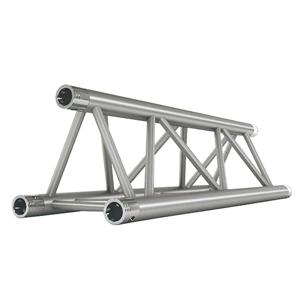
Scaffolding beams are the horizontal load-carriers in every slab formwork system, scaffold deck, and bridge falsework across UAE construction sites. Whether you need H20 timber beams for concrete slab forming, steel decking beams for access scaffolding, or heavy-duty steel sections rated for 2,600 kg UDL - this guide covers every product type, real specs from UAE-stocked products, and five verified suppliers in Dubai, Sharjah, and Ajman.
|
1.5 – 5.9 m
H20 beam length range stocked in UAE
|
2,600 kg
UDL rating - heavy duty steel beam (Arfuf)
|
200 mm
H20 beam standard height - formwork industry
|
Steel & Aluminum
Beam materials |
High-rise concrete slabs in Dubai, industrial maintenance in Sharjah, bridge decks in Abu Dhabi - all need the right beam type.
A scaffolding beam is a horizontal structural member that carries the load of workers, materials, and formwork across a scaffold platform or slab forming system. In the UAE's fast-paced construction market - where high-rise towers in Dubai, industrial plants in Sharjah, and infrastructure projects in Abu Dhabi run simultaneously - beam selection directly affects both site safety and programme delivery.
Q: Do I need a scaffolding beam or a scaffold tube - what's the difference?
Scaffold tubes are vertical or diagonal members forming the frame structure. Beams are the horizontal, load-bearing elements that span between verticals - they carry the deck or formwork plywood. Beams are designed to resist bending across a span; tubes resist axial (compressive) load. Wrong selection leads to deflection or failure under load.
Three distinct beam categories are stocked across UAE suppliers - each designed for a different application, load case, and scaffolding system. Mixing beam types or using a formwork beam in a scaffolding platform application is a structural safety error.
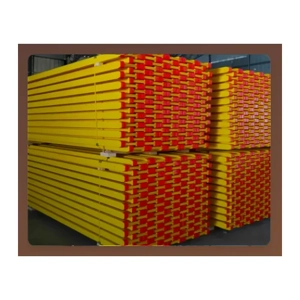
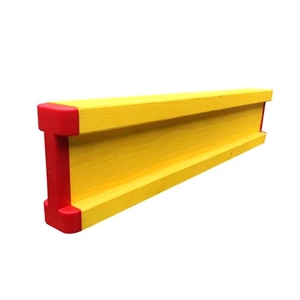
The H20 is an engineered timber I-beam: two flanges (timber chords) bonded to an LVL or plywood web, forming an H cross-section 200mm tall. It combines the bending resistance of a steel section with the workability and light weight of timber - cutting on site with a circular saw, unlike steel beams.
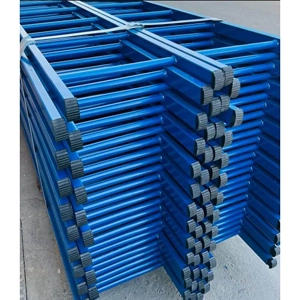
A galvanized steel beam used to form the decking platform of access scaffold systems. End hooks or spigots lock into the scaffold standard cups or ledger sockets. Designed for frequent assembly and disassembly - the section profile and end connections match the scaffold system on site.
A purpose-engineered steel section for heavy load applications where standard H20 or light scaffold beams are insufficient. Rated to 2,600 kg UDL - significantly above the capacity of standard decking beams. Used on bridge falsework, heavy industrial maintenance, and shoring operations.
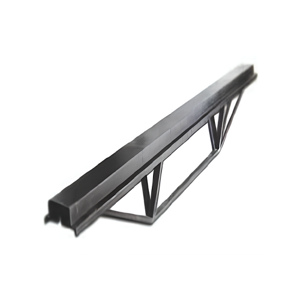
A lattice beam is a fabricated steel truss - two parallel chords connected by a diagonal web of steel rods or hollow sections. The open triangulated structure gives it extraordinary bending strength for its weight. Where an H20 timber beam might span 5.9m and a standard steel decking beam 2.5m, a lattice beam can clear 6m, 9m, even 12m+ with no intermediate support - critical on UAE bridge decks, long-span industrial roofs, and floor slabs over ground-floor retail podiums where columns can't be placed.
Aluminium scaffold beams sacrifice some raw load capacity compared to steel but cut weight by 60–65% for equivalent section dimensions. On a Dubai hotel facade or an Abu Dhabi event stage where the beam must be carried manually up multiple floors, or where the substrate cannot take high point loads from heavy steel, aluminium is the correct material choice.
These are not generic beams - they are proprietary horizontal members engineered specifically for one scaffold system's node connector. A Cuplock ledger clips into the top and bottom cups of a Cuplock standard; a Kwikstage ledger hooks into the Kwikstage rosette; a Ringlock horizontal pins through the Ringlock node. They are structural members, not accessories - and they must match the system on site exactly.
Q: Which scaffolding beam should I order - H20 timber, steel decking, or heavy duty steel?
It depends entirely on what the beam is supporting. Concrete formwork: H20 timber. Scaffold platform decking: steel decking beam (Ascend). Heavy industrial or bridge load: A18060 heavy duty steel. Using any of these interchangeably is a structural failure risk.
| Product | Material | Sizes / Section | Load Rating | UAE Use |
|---|---|---|---|---|
| H20 Beam | Engineered timber | 200mm H, 1.5–5.9m L | Span-dependent (formwork tables) | Slab formwork |
| Decking Beam (Ascend) | Galvanized steel | 100mm W, 1.2 / 1.8 / 2.5m | EN 12811 platform rated | Access scaffolding platforms |
| Heavy Duty Beam A18060 | Steel | 80×50×1.6mm, 2000mm | 2,600 kg UDL | Bridge, heavy industrial |
| H20 Wooden Beam 200mm | Laminated timber | 200mm H, custom length | Formwork load tables | High-rise concrete floors |
A Dubai contractor notices H20 beams visibly sagging under the weight of plywood and wet concrete before the pour is complete. Mid-span deflection beyond 1/500 of the span causes the slab soffit to be out of tolerance and the beam edges to separate.
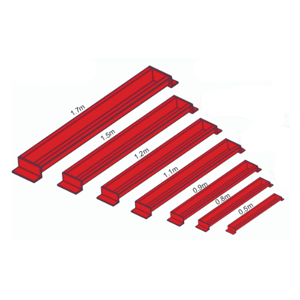
Fix: Check the beam span against the manufacturer's load table - H20 beams have a maximum recommended span for a given slab load that is frequently exceeded on UAE sites when props are removed to accelerate floor-stripping cycles. Reduce prop spacing or step down to a shorter beam length. Dar Al Taqa (Dubai) stocks H20 beams from 1.5m to 5.9m - discuss span and slab depth requirements before ordering so the correct length is specified.
Timber H20 beams left stored horizontally on an Abu Dhabi site without cover during the June-August humidity period show flange splitting at the web-chord glue line - the engineered timber bond fails when repeatedly wet and dried.
Fix: Store H20 beams off the ground on timber bearers, stacked horizontally, covered with a breathable tarpaulin - not wrapped in polythene which traps moisture. Keep beam ends painted or sealed with end-grain sealant to reduce moisture uptake through the most vulnerable cross-section. Inspect for delamination before each reuse; a delaminated H20 beam carries a fraction of its rated load. Al Naseeha Building Materials (Dubai) and Dar Al Taqa (Dubai) supply H20 beams - ask about product storage guidance at the point of purchase.
A Sharjah scaffolding contractor finds that steel decking beams stored on site for three months have corroded end hooks that jam in the Kwikstage standard cups and can no longer be quickly inserted or released during assembly.
Fix: Scaffolding steel in the UAE's coastal humidity - particularly in Sharjah, Dubai, and Abu Dhabi coastal areas - degrades faster than in temperate climates. After each project, clean beams, wire-brush any rust on the hooks, apply a thin oil coat, and store off the ground under cover. When purchasing new decking beams, specify hot-dip galvanized finish rather than painted or electro-galvanized - the coating thickness is significantly greater and lasts longer in UAE field conditions. Ascend Access Systems (Dubai) manufactures decking beams specifically for UAE conditions.
A procurement officer on a Dubai fit-out project orders H20 beams after seeing "scaffold beam" on a supplier list - they arrive on site and cannot be used because the scaffold system needs steel decking beams with end-hook connectors, not raw timber I-beams.
Fix: Always specify beam type, scaffold system, and intended application in the purchase order - not just "scaffold beam." H20 timber = formwork only. Steel decking beams with end hooks = access scaffold platforms. Heavy duty steel sections = bridge/industrial. Contact Ascend Access Systems (Dubai) for platform decking beams compatible with their scaffolding system, or New Ammar Scaffolding (Ajman) for H20 beams for formwork applications.
Five stocked suppliers across Dubai, Sharjah, and Ajman with actual products and specifications.
Best for: Contractors seeking a single supplier for H20 timber beams, decking beams, and steel infill beams used in concrete slab formwork, bridge construction, commercial towers, industrial facilities, villas, and infrastructure projects across Ajman, Sharjah, and the Northern Emirates with dependable local availability and faster site delivery.
Best for: EPC contractors, scaffolding companies, formwork specialists, facade access contractors, industrial maintenance firms, and equipment rental providers looking for a complete range of H20 timber beams, lattice beams, decking beams, infill beams, and lightweight aluminum S150 & T150 beams for high-rise buildings, bridges, airports, power plants, refineries, warehouses, and infrastructure projects throughout the UAE.
Best for: Bridge falsework, heavy shoring, and industrial maintenance applications in UAE where standard H20 or light decking beams are structurally insufficient for the load case.
Best for: Building contractors, civil engineers, formwork subcontractors, and general builders seeking H20 timber beams, decking beams, and infill beams together with other construction materials from a single Dubai supplier for residential, commercial, warehouse, and infrastructure projects across the UAE.
Best for: Main contractors and formwork subcontractors needing the full H20 length programme in a single UAE source - 11 lengths from 1.5m to 5.9m means no custom cutting and less site waste.
Five things to confirm before ordering any scaffolding beam in UAE:
An engineered timber I-beam with a 200mm cross-section height used as a horizontal spanning element in concrete slab formwork. Available in the UAE from 1.5m to 5.9m lengths. Used under plywood decking to carry wet concrete load in high-rise slab construction across Dubai, Abu Dhabi, and Sharjah.
H20 is a formwork product for concrete slab construction - timber, not interchangeable with scaffolding system components. Steel decking beams (like the Ascend 100mm-wide range) are galvanized steel platform components for access scaffolding. Different function, different connectors, different load cases.
The A18060 (80×50×1.6mm, 2000mm length) manufactured by Arfuf AlKhaleej Metal Industries in Sharjah carries 2,600 kg UDL - the highest rated scaffold beam currently listed by UAE suppliers. Used for bridge falsework, heavy industrial maintenance, and shoring where standard beams are insufficient.
A ledger is a standard horizontal component that ties adjacent scaffold standards together at a fixed bay length. A beam is engineered to span a longer, unsupported gap - a stairwell, a loading bay, a cantilevered section - and carry a concentrated load across that span. Beams are typically deeper, stronger, and used far less frequently than ledgers within a given rig.
Steel beams carry more load over a given span and suit heavy construction, industrial, and formwork applications. Aluminum beams are lighter and faster to handle and reposition, which suits facade maintenance and event work where the load is lighter and the beam moves frequently. Match the beam to the actual load and span, not just the site type.
No. Each system uses a different joint mechanism, and beam brackets are engineered to match one specific joint type. A Cuplock beam bracket will not connect to a Kwikstage rosette standard. Always confirm the system name before ordering a beam bracket or cantilever frame.
UAE-based manufacturers with local stock typically deliver within days of order confirmation. Imported beams or highly custom specifications can carry 6–12 week lead times. Confirm stock availability at quotation stage if your schedule is tight.
For Dubai buyers: Ascend Access Systems Scaffolding LLC, Al Naseeha Building Materials Trading, and Dar Al Taqa Building and Construction Material Trading are all Dubai-based. For Ajman, Sharjah, and the Northern Emirates, New Ammar Scaffolding Trading LLC (Ajman) and Arfuf AlKhaleej Metal Industries cover that side of the market.

 0
0