A scaffold guardrail - also called a scaffold safety guardrail, protection rail, edge barrier, or scaffold edge protection system - is the barrier that stops a worker going over the open edge of a platform, and it's the single component most directly tied to scaffold fall protection. This page compares verified UAE guardrail suppliers with a plain-language guide to guardrail types, standards, rental options, and the questions buyers actually ask before ordering.
A guardrail sits above the deck boards along any open edge of a scaffold platform, typically as a top rail at around waist height with a midrail below it, working together with toe boards to close off the fall risk from top to bottom. Some suppliers and standards refer to the same setup as a "temporary edge protection" system, since it's installed and removed with the scaffold itself rather than being a permanent building feature. Unlike a toe board, which stops tools and materials sliding off at foot level, a guardrail's job is stopping a person from going over the edge - which is exactly why it's specified and inspected more strictly than almost any other scaffold component.
Who is this page for? Site engineers specifying edge protection for a scaffold design, main contractor safety officers auditing existing guardrail stock, scaffolding rental companies restocking guardrails between hires, and fit-out contractors setting up a compliant internal access tower. Below are two verified UAE suppliers, a type-by-type buyer's guide, sizing guidance, and answers to common buyer questions.
|
Edge Protection
Primary purpose
|
~1000 mm
Typical top rail height above deck
|
48.3 mm
Standard scaffold tube diameter
|
Top + Mid Rail
Minimum standard guardrail setup
|
Q: Is one guardrail enough, or do I need a midrail too?
A single top rail on its own leaves a gap a person could still fall through underneath it. The standard setup on almost every scaffold platform is a top rail plus a midrail, with toe boards closing the gap at deck level - together these three components form the full edge-protection package. Skipping the midrail to save on components is one of the most common (and easiest to spot) compliance gaps on a poorly set up scaffold.
| Guardrail Type | Typical Material | Typical Dimensions | Primary Function | Best For |
|---|---|---|---|---|
| Standard Top Rail | Galvanized Steel | ~48.3 mm tube, ~1000 mm above deck | Primary fall barrier along the open edge | Every open scaffold platform edge |
| Midrail | Galvanized Steel | ~48.3 mm tube, ~mid-height between deck and top rail | Closes the gap beneath the top rail | Pairing with every top rail installation |
| Corner / Return Guardrail | Galvanized Steel | ~48.3 mm tube, angled fitting | Wraps protection around external corners | L-shaped or wrap-around platform edges |
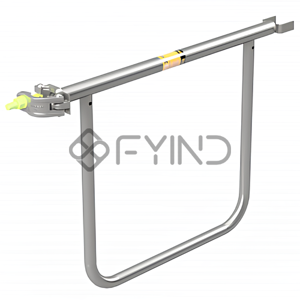
| Adjustable / Telescopic Guardrail | Galvanized Steel | ~48.3 mm tube, telescoping length | Fits irregular or non-standard bay widths | Non-standard bays, rental fleets needing fewer SKUs |
| Clamp-On Guardrail Post | Galvanized Steel | ~48.3 mm tube fit | Vertical post clamped to the standard, holding the rails | Tube-and-clamp scaffold systems |
| Modular Guardrail Frame | Galvanized or Powder-Coated Steel | ~48.3 mm tube, pre-fabricated frame unit | Pre-assembled top rail + midrail as one clip-in frame | Fast erection on Cuplock, Ringlock, or Kwikstage systems |
Dimensions marked with a tilde (~) are common industry-typical values for buyer reference, not confirmed specs from either supplier below - always confirm exact sizing directly before ordering.
Two verified suppliers listed on fyind.com - call ahead with your guardrail type, length, and quantity for the fastest quote.
Serves: UAE-wide | View Supplier Profile
Al Naseeha Building Materials Trading Co LLC is a verified UAE building materials trader listed under scaffolding guardrails, alongside its verified scaffold board, brace, clamp, and jack listings covered elsewhere in this series. If you're already sourcing other scaffold components from Al Naseeha, adding guardrails to the same order is worth asking about. Confirm exact guardrail type, length, and quantity by phone, since specific product listings weren't available to verify at the time of writing.
Phone: 04 885 5001 | Location: Nad Al Hamar, Dubai, UAE | View Supplier Profile
Ascend Access Systems Scaffolding LLC is listed as both a manufacturer and supplier and already appears in this series as one of the widest-range access equipment suppliers in the UAE, covering boards, braces, clamps, jacks, and props. That breadth makes them a sensible call if you want guardrails sourced alongside a broader access equipment package from a single Dubai-based supplier. Confirm exact guardrail type, length, and quantity when you call.
Run any guardrail option through the same short checklist before ordering:
Not every scaffold guardrail fits every scaffolding system. Before ordering, confirm that the guardrail dimensions, connection method, and fixing points match your existing scaffold. Choosing a compatible guardrail improves installation speed, maintains structural integrity, and helps meet site safety requirements.
| Scaffolding System | Guardrail Compatibility | Typical Application |
|---|---|---|
| Ringlock Scaffolding | Purpose-built modular guardrails that lock directly into Ringlock standards. | High-rise buildings, industrial plants, and infrastructure projects. |
| Cuplock Scaffolding | Fixed or modular guardrails designed for Cuplock ledgers and standards. | Commercial construction, bridges, and large civil engineering works. |
| Kwikstage Scaffolding | Guardrails matched to Kwikstage transoms and platform configurations. | Residential, industrial, and maintenance projects. |
| Tube & Clamp Scaffolding | Standard scaffold tubes secured using fixed or swivel couplers for maximum flexibility. | Complex structures, refurbishment, and irregular building layouts. |
| H-Frame / Frame Scaffolding | Frame-specific guardrails designed to fit H-frame scaffold systems. | General building construction, plastering, and painting work. |
Before purchasing scaffold guardrails, verify the scaffold system type, platform width, bay length, connection method, and applicable safety standards. If you're expanding an existing scaffold, confirm compatibility with your current components to ensure safe installation and reliable edge protection.
How you source guardrails usually comes down to how long you need them and how many:
Q: How high should a scaffold guardrail be?
Top rails are commonly positioned around 1000 mm above the working platform, with a midrail roughly midway between the top rail and the deck, closing the largest gap a person could fall through. Guardrail tube is typically 48.3 mm to match standard scaffold tube, fitted with fixed or swivel clamps depending on the joint angle. Scaffold guardrail standards on exact height and midrail spacing can vary by the specific code your project references, so always confirm against your project's applicable standard rather than assuming a single fixed figure.
Q: Galvanized, powder-coated, or heavy duty - which finish should I choose?
Galvanized steel is the default for long-term outdoor and coastal UAE exposure, since the zinc coating resists corrosion better over years of use than a painted finish. A powder-coated guardrail gives a smoother, often colour-coded painted finish that's popular for shorter-term projects, indoor use, or event/exhibition staging where appearance matters as much as durability. Heavy duty scaffold guardrail variants use thicker-wall tube or reinforced fittings for industrial sites with higher impact risk or wind exposure - worth specifying explicitly rather than assuming standard-duty stock will do.
The figures below are a general market guide, not a quote from either supplier named on this page. Pricing depends on length, tube diameter, finish, and order volume, and moves with steel costs over time.
| Guardrail Type | Typical AED Range (per piece) | What Moves the Price |
|---|---|---|
| Standard top rail / midrail | AED 30 – 60 | Length, tube thickness, and coupler/clamp type |
| Corner / return guardrail | AED 40 – 75 | Angled fitting adds cost over a straight rail |
| Adjustable / telescopic guardrail | AED 60 – 120 | Telescoping mechanism and locking hardware |
Note: these ranges are indicative market pricing for guidance only and are not quotes from Al Naseeha Building Materials Trading Co LLC or Ascend Access Systems Scaffolding LLC specifically.
| Problem | Why It Happens | Fix |
|---|---|---|
| Missing midrail | Only the top rail gets fitted to save time, leaving a fall gap underneath | Treat top rail + midrail as one non-negotiable set during every erection sign-off |
| Unprotected corners | Straight rails don't naturally wrap around an external corner or return | Fit a dedicated corner/return guardrail rather than leaving a gap at the angle |
| Bent or dented rail | Impact damage during erection, dismantling, or material handling nearby | Inspect before every reuse; retire - don't straighten - a structurally bent rail |
| Loose coupler/clamp fitting | Under-torqued at installation or worked loose by vibration over time | Torque to spec at installation; recheck fittings periodically on high-traffic platforms |
The top rail is the uppermost horizontal member of a scaffold guardrail, fitted at around 1000 mm above the platform. It's the primary barrier a worker would lean or fall against at the open edge.
The midrail sits roughly halfway between the top rail and the platform deck, closing the gap a person could otherwise fall through beneath the top rail alone. It's fitted as standard alongside every top rail, not as an optional extra.
A return guardrail is a short section that wraps a guardrail run around an external corner or the end of a platform, so the edge protection continues unbroken around the angle instead of stopping at the last straight section.
A handrail is typically associated with a stair or ramp, giving something to hold onto while moving up or down. A scaffold guardrail is fixed edge protection along a platform's open side, designed to stop a fall rather than assist movement - the terms sometimes get used loosely, but they serve different functions.
Inspect every guardrail before reuse for bends, dents, and corrosion, check that coupler or clamp fittings are still torqued correctly, and retire - rather than straighten - anything structurally damaged. Guardrails stored between projects should be kept off damp ground to slow corrosion on galvanized or powder-coated finishes.
Choose fixed for standard, repeated bay widths - it's simpler and cheaper. Choose adjustable (telescopic) when bay widths vary or aren't confirmed yet, since one adjustable guardrail can cover a range of lengths that would otherwise need several different fixed sizes in stock.
A guardrail (top rail and midrail) stops a person falling over the open edge of a platform. A toe board sits at deck level and stops tools or materials sliding off - the two work together but protect against different risks.
Yes. A top rail alone leaves a gap underneath it that a person can still fall through. Top rail and midrail together are treated as the standard minimum edge-protection set.
Use a dedicated corner or return guardrail designed to wrap around the angle, rather than trying to butt two straight rails together, which typically leaves a gap right at the corner.
Contact the suppliers above directly with your required guardrail type, length, and quantity. Pricing depends on all of those details plus current steel costs, so it isn't something a generic price list can reflect accurately.