

If a bracket is the part that adds something extra to a scaffold, a coupler is the part that holds the whole thing together in the first place. Every tube-to-tube joint on a traditional scaffold - vertical to horizontal, horizontal to horizontal, or angled - runs through a coupler. Get the wrong one and the joint either won't clamp tight or won't take the load.
Quick question: is your scaffold tube-and-clamp/tube-and-fitting, or a modular system like Cuplock, Kwikstage, or Ringlock? Couplers are the tube-and-fitting world's equivalent of a bracket - if you're on a modular system, you may actually want our scaffolding brackets page instead. If you're joining plain 48.3mm tube, you're in the right place.
|
0.55 – 1.5 kg
Typical coupler weight |
48.3 mm
Standard tube diameter fit |
Forged or
Pressed Steel Common material types |
BS EN 74
Common compliance standard |
| Coupler Type | Joint Type | Best For | Typical Weight |
|---|---|---|---|
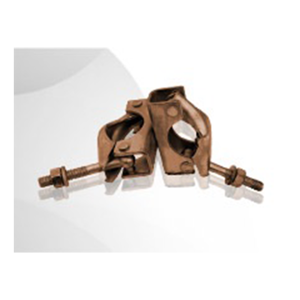
| Right-Angle / Double Coupler | Fixed 90° | Standard perpendicular joints | 0.60 – 1.5 kg |
| Swivel Coupler | Adjustable, any angle | Diagonal bracing, irregular joints | 0.86 – 1.05 kg |
| Sleeve Coupler | In-line, tube-to-tube | Extending tube length | Varies |
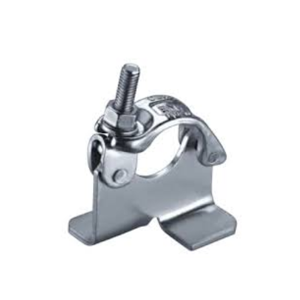
| Putlog / Single Coupler | Single tube to ledger | Supporting board ends, non-load transoms | 0.55 kg |
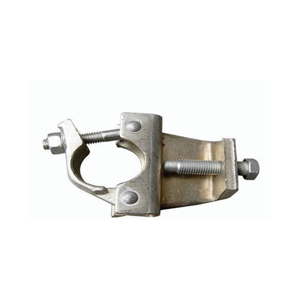
| Beam / Girder Coupler | Tube-to-beam flange | Clamping onto steel beams/girders | 1.15 – 1.54 kg |
| Board Retaining Coupler | Tube-to-board edge | Holding scaffold boards in place | Varies |
| BRC / Rebar Coupler | Bar-to-bar (mesh/rebar) | Connecting reinforcement bars, not tube | ~0.60 kg |
Suppliers across Dubai and Ajman, with item-level specs pulled directly from their published fyind catalogues.
Location: Ajman, UAE | Serves: Ajman, Sharjah, Dubai, Northern Emirates | Whatsapp: +971 54 218 8478
New Ammar's six-product range covers the core joint types a tube-and-fitting scaffold actually needs - a fixed right-angle option (Double Coupler), an angled option (Drop Forged Swivel Coupler), an extension option (Sleeve Coupler), plus a beam clamp and a rapid clamp for faster fit-up. It's a compact but complete starter set rather than a deep multi-variant catalogue. Their Ajman base makes them a practical first call for Ajman, Sharjah, or Northern Emirates sites.
Phone: +971 4 589 2555 | Mobile: +971 52 682 4374 | Location: Dubai, UAE
Al Naseeha publishes the deepest coupler range in this list - nine distinct SKUs spanning both drop-forged and pressed sheet-metal construction across double, swivel, sleeve, girder, rosette, and putlog types. That forged-vs-pressed split within the same catalogue is genuinely useful: it means you can specify the heavier, higher-load forged version (Girder Coupler at 1.536 kg, Drop Forged Swivel at 1.05 kg) for structural joints, and drop down to the lighter pressed sheet-metal equivalents for non-critical connections on the same order, all from one supplier.
Phone: +971 4 885 5001 | Location: Nad Al Hammar, Dubai, UAE | Serves: Dubai, Abu Dhabi, Sharjah, RAK, Fujairah, Ajman, UAQ
Ascend's six-item range is the only one in this list to include a Board Retaining Coupler, which matters if boards keep shifting on your transoms and you'd rather fix that at the coupler level than add a full toe board run - see our scaffolding boards page for the toe board alternative. Combined with their Double, Swivel, Putlog, and Gravelock/Girder couplers, it's a well-rounded set covering standard structural joints, angled bracing, and board retention from one Dubai manufacturer.
Location: Ajman, UAE | Serves: Ajman, Dubai, Northern Emirates | confirm current phone directly via their fyind listing or website
Mufaddal Raj is a broad building materials trader - electrical, plumbing, sanitary ware, tools, aggregates - with the BRC coupler as their one specifically published item under the scaffolding coupler category on fyind. If BRC coupler is genuinely what you need, the spec sheet (zinc-plated, 0.60 kg, 20.5 mm hex nut, BSW thread) is fully published. For scaffold tube couplers (right-angle, swivel, sleeve), check directly since those aren't confirmed on their public catalogue.
Location: Ajman, UAE | Serves: Ajman, Sharjah, Dubai, Northern Emirates | confirm current phone directly via their fyind listing
Al Dereya's 15-item range is the broadest and most segmented in this list - the standout is that several types come in more than one duty rating (Fixed Coupler in both light-duty and combination variants, Swivel Coupler in both light-duty and standard), which lets you match spend to the actual load rather than defaulting to one grade across the whole site. The staircase-specific, fencing-specific, and tie rod connector items also cover applications the other four suppliers on this page don't list explicitly.
On a traditional tube-and-fitting scaffold, nothing is welded and nothing is bolted through pre-drilled holes - every joint is a clamp. A coupler is that clamp: two curved jaws, a nut and bolt (or a wedge, depending on design), tightened around two tubes to lock them together. The reason there are so many "types" isn't marketing - it's that a joint running straight through at 90 degrees, a diagonal brace at some odd angle, and a tube extended in a straight line are three completely different mechanical problems, and each has its own coupler.
So how do you tell them apart quickly? Ask what the two tubes are doing relative to each other:
The question this answers: "Two tubes cross at 90 degrees and this joint needs to carry real load - what do I use?" A right-angle (double) coupler, full stop. It's the most common coupler on any tube-and-fitting scaffold, clamping standards to ledgers and ledgers to transoms at fixed perpendicular joints.
Best for: Standard structural joints throughout a tube-and-fitting scaffold. Weights in UAE catalogues typically run 0.60–1.5 kg depending on forged vs. pressed construction.
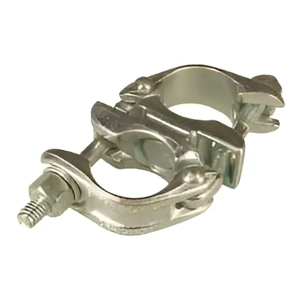
The question this answers: "I need a diagonal brace across this bay - can I use the same coupler as the rest of the frame?" No - a right-angle coupler is fixed at 90 degrees and physically can't clamp a diagonal joint properly. A swivel coupler pivots to whatever angle the brace actually sits at.
Best for: Diagonal bracing, curved scaffold runs, any non-perpendicular joint. Typical weight around 0.86–1.05 kg for drop-forged versions.
The question this answers: "My tube stock is 4m long but I need a 6m run - do I need a new longer tube?" No - a sleeve coupler joins two tube ends in a straight line, effectively extending the length without sourcing a single longer piece.
Best for: Extending standards or ledgers beyond standard stock lengths. Confirm the internal fit against your exact tube diameter before ordering.
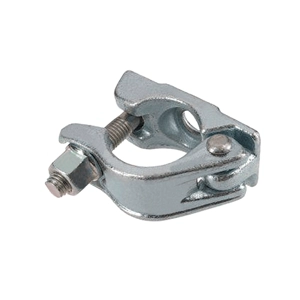
The question this answers: "This tube just needs to sit against the wall and support a board end - do I need a full structural coupler?" No, and using one wastes money. A putlog (single) coupler is designed for this lighter, non-load-transferring connection specifically.
Best for: Supporting putlogs and board ends against a wall face. Typical weight around 0.55 kg for forged versions.
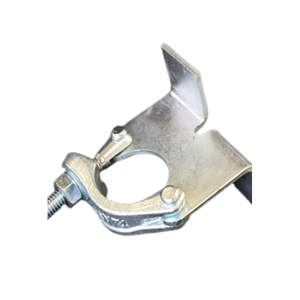
The question this answers: "I need to anchor a scaffold tube onto an existing steel beam or girder flange, not another tube - what connects the two?" A beam (or girder) clamp coupler, purpose-built to grip a flat steel flange rather than a round tube.
Best for: Anchoring scaffold tube onto structural steelwork. UAE catalogue weights run roughly 1.15–1.54 kg depending on the flange size it's rated for.
The question this answers: "My scaffold boards keep shifting on the transoms - is there a fitting for that?" Yes - a board retaining coupler clamps onto the transom and holds the board edge in place, stopping lateral movement without a full toe board run.
Best for: Preventing board movement on tube-and-fitting platforms. Not a substitute for toe boards where edge-protection compliance is required - see our scaffolding boards page for toe board options.
Couplers are priced per piece and bought in bulk - most UAE suppliers price on request rather than publishing a list, so use these as bands to check a quote against.
Most suppliers offer couplers manufactured from drop forged or pressed steel with zinc-plated, electro-galvanized, or hot-dip galvanized finishes. Products complying with EN 74 or BS 1139 standards may command a higher price due to their certified quality and structural performance.
| Coupler Type | Typical UAE Price (Bulk) | Common Applications |
|---|---|---|
| Right Angle (Universal) Coupler | AED 8 – 18 | Standards, ledgers, primary scaffold connections |
| Swivel Coupler | AED 12 – 22 | Diagonal bracing and angled tube connections |
| Sleeve Coupler | AED 10 – 20 | Joining scaffold tubes end-to-end |
| Putlog (Single) Coupler | AED 8 – 18 | Supporting transoms and scaffold boards |
| Board Retaining Coupler | AED 10 – 20 | Securing scaffold boards |
| Beam (Girder) Coupler | AED 25 – 60 | Connecting scaffolding to structural steel beams |
| Ladder Clamp | AED 15 – 25 | Securing ladders to scaffold structures |
Note: The prices above are indicative UAE market ranges for bulk purchases and may vary based on quantity, supplier, steel prices, finish, and certification requirements. Always request a quotation from verified scaffolding coupler suppliers before placing an order.
A right-angle (double) coupler is fixed at 90 degrees and used for standard structural joints. A swivel coupler pivots to any angle, which makes it the correct choice for diagonal bracing or any joint that isn't perfectly square. Using a right-angle coupler on an angled joint means it won't clamp properly.
No. A BRC coupler connects reinforcement bar or mesh sections - it has nothing to do with joining scaffold tube. It appears under the same "scaffolding coupler" product category on some UAE supplier catalogues purely by classification. Double-check the product spec before ordering if a supplier lists it alongside genuine scaffold couplers.
Drop-forged couplers cost more but generally carry a higher load rating and hold up better to repeated use. Pressed sheet-metal couplers are lighter on the budget and fine for lower-load or shorter-duration applications - just confirm the load rating matches your actual joint requirement rather than assuming.
Al Naseeha Building Materials Trading and Ascend Access Systems Scaffolding LLC are both Dubai-based. New Ammar Scaffolding Trading LLC, Mufaddal Raj Building Material Trading, and Al Dereya Scaffolding Trading LLC are all based in Ajman, covering the Northern Emirates directly.
In practice, the terms scaffold clamp and scaffold coupler are often used interchangeably in the UAE construction industry. A coupler is the technical name for the fitting that joins scaffold tubes, while clamp is the more commonly used trade term. Depending on the application, scaffold couplers include right-angle (universal), swivel, sleeve, putlog, board retaining, beam (girder), and ladder clamps, each designed for a specific type of scaffold connection.
A swivel coupler is the correct choice for diagonal bracing because it allows two scaffold tubes to be connected at virtually any angle. Unlike a right-angle coupler, which forms a fixed 90-degree joint, a swivel coupler rotates through 360° before being tightened, making it ideal for cross braces that improve scaffold stability and resistance to lateral movement.
The right-angle (universal) coupler, particularly a drop forged version manufactured to EN 74 or BS 1139 standards, is generally designed to carry the highest structural loads in tube-and-fitting scaffolding. It forms the primary connection between standards and ledgers, making it one of the most critical load-bearing couplers in a scaffold system. Always follow the scaffold design and manufacturer's load ratings for safe installation.
Bridge scaffolding typically uses a combination of right-angle couplers, swivel couplers, and beam (girder) couplers. Right-angle couplers create the main structural framework, swivel couplers secure diagonal bracing for additional stability, and beam couplers connect the scaffold directly to structural steel where required. The exact combination depends on the bridge design and engineering specifications.
Oil and gas facilities commonly use drop forged right-angle couplers, swivel couplers, sleeve couplers, and beam (girder) couplers manufactured to EN 74 or BS 1139 standards. Hot-dip galvanized or corrosion-resistant finishes are generally preferred because they provide better protection in harsh industrial and offshore environments. Couplers should always meet the project's safety and engineering requirements.
For marine and coastal environments, hot-dip galvanized scaffold couplers are generally recommended because they offer superior corrosion resistance compared with standard zinc-plated fittings. Right-angle, swivel, sleeve, and beam couplers are commonly used depending on the scaffold design, while selecting couplers manufactured to recognised standards such as EN 74 or BS 1139 helps ensure durability and safe performance in demanding marine conditions.

 0
0