Crane Catastrophe Avoidance - Why UAE's $1 Trillion Construction Sector Can't Afford a Counterbalance Valve Failure
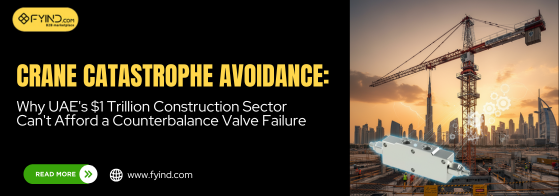
Let's take a moment to discuss the size of construction in UAE. It's nearly astounding, not just impressive. With a market estimated at around $67 billion and expected to reach over $96 billion by 2030, the skyline is not only expanding but also rapidly changing. Cranes are the cornerstone of this boom, which is driven by a vision for a diverse, future-proof economy. The unsung heroes of every major project are tower cranes, mobile cranes, and crawler cranes.
But what if I told you that a single, fist-sized part buried deep within a crane's hydraulic system frequently determines the safety and success of these multibillion-dollar projects? a part known as a counterbalance valve (CBV).
There is more than just a slight delay when this tiny component fails. They are costly, disastrous, and capable of stopping even the most ambitious undertaking.
The Staggering Cost of a Single Failure
Downtime is the enemy in a setting with strict deadlines and harsh consequences. "Liquidated Damages" clauses, which can penalize delays up to AED 20,000 (about $5,450) each day, are frequently seen in construction contracts in this area. Imagine now that all lifting activities are halted for a week due to a crane failure. The financial damage is instantaneous.
However, downtime is not the only consequence of a counterbalance valve failure. It has to do with disaster. A runaway load—an uncontrollable drop of the crane boom and whatever it is carrying—can result from a failed CBV. In addition to damaging the load, the ensuing collision may result in the collapse of the crane.
The costs then skyrocket:
Direct Accident Costs: Each major occurrence can cost more than $415,000 in medical, compensation, and disruption.
Project Delays: The location has been closed for cleanup and investigation. The daily fines continue to mount up.
Equipment Damage: The crane might be a complete loss, requiring a write-off of several million dollars.
Reputational and Legal Damage: Lawsuits, insurance probes, and a negative mark that can cost future contracts.
Choosing a high-quality counterbalance valve is an essential financial and legal precaution in this high-stakes situation, not just an engineering choice.
The Unsung Hero: What a Counterbalance Valve Actually Does
What does this crucial element perform, then? For a load hung in the air, consider the counterbalance valve to be the ultimate safety of the sentinel. It serves two purposes:
Load Holding: It firmly secures the load. A working CBV will stop the boom or load from drifting or falling even if all hydraulic pressure is lost.
Controlled Descent: This is its most important role. Gravity wants to take over while a load is being lowered. The load lowers gently and is under control thanks to the CBV's accurate back pressure. It stops the unsteady, jerky motion that causes collapse and shock loads.
It differs from a more straightforward pilot-operated check valve because of this. Although a check valve can lock a load, its sudden action can result in hazardous shaking. High-stakes lifting requires smooth, stable control, which is why the CBV is a precision modulator.
How Failure Happens: The Runaway Load
When a counterbalance valve's internal mechanism is weakened—by a worn seal, a worn-out spring, or abrasive contamination—it fails. When it doesn't work, it absolutely fails. It immediately lost the back pressure it was sustaining.
You receive a runaway load at this point.
Uncontrollably, the boom and load plummet. This is a violent, accelerated fall rather than a leisurely drift. The tremendous amount of energy produced causes shock waves that go well beyond the hydraulic system's and the crane's structural limitations. Cylinders may break; structural steel may rip, and the machine may collapse as a result. The destructive power is enormous.
The UAE’s Harsh Environment is an Accelerant
The harsh weather in the UAE actively opposes these essential elements.
Extreme Heat: Prolonged high temperatures cause hydraulic fluid to thin, lubrication to decrease, and seals to bake until they shatter and become brittle. A concealed time bomb could occur if a valve that was properly set in the morning fails to maintain pressure in the afternoon heat.
Abrasive Dust: Everything is penetrated by fine desert dust. It functions similarly to sandpaper within a CBV, causing the valve to stick or leak internally and scoring precision surfaces.
Regular, off-the-shelf parts are not reliable in this situation. The environment demands a higher level.
How to Build in Safety: A Zero-Failure Mindset
Three areas must be the emphasis of a proactive, disciplined approach to disaster prevention:
1. Strategic Procurement: Choose the right part for the job rather than just purchasing it. Employ a framework such as the STAMPED protocol, taking note of:
Temperature (T): Request Viton (FKM) high-temperature seals.
Media (M): Make use of premium hydraulic fluid that is thermally stable.
Pressure (P): Verify that the valve's rating is at least 1.3 times the maximum load pressure.
2. Strict Maintenance: Preventing issues is more important than correcting them.
3. Adhere to Regulations: Every two years, the UAE requires thorough crane inspections, including non-destructive testing (NDT). These are necessary examinations that can identify wear and microfractures before they become failures, not bureaucratic roadblocks.
There is no margin for error in the trillion-dollar building industry in the UAE. Selecting a single, crucial part, such as a counterbalance valve, is an investment in project security, financial stability, and worker safety. The industry may continue to construct its future in a safe and effective manner by comprehending its role, honoring the processes of its failure, and putting in place a culture of premium specification and careful maintenance.
Let's take a moment to discuss the size of construction in UAE. It's nearly astounding, not just impressive. With a market estimated at around $67 billion and expected to reach over $96 billion by 2030, the skyline is not only expanding but also rapidly changing. Cranes are the cornerstone of this boom, which is driven by a vision for a diverse, future-proof economy. The unsung heroes of every major project are tower cranes, mobile cranes, and crawler cranes.
But what if I told you that a single, fist-sized part buried deep within a crane's hydraulic system frequently determines the safety and success of these multibillion-dollar projects? a part known as a counterbalance valve (CBV).
There is more than just a slight delay when this tiny component fails. They are costly, disastrous, and capable of stopping even the most ambitious undertaking.
The Staggering Cost of a Single Failure
Downtime is the enemy in a setting with strict deadlines and harsh consequences. "Liquidated Damages" clauses, which can penalize delays up to AED 20,000 (about $5,450) each day, are frequently seen in construction contracts in this area. Imagine now that all lifting activities are halted for a week due to a crane failure. The financial damage is instantaneous.
However, downtime is not the only consequence of a counterbalance valve failure. It has to do with disaster. A runaway load—an uncontrollable drop of the crane boom and whatever it is carrying—can result from a failed CBV. In addition to damaging the load, the ensuing collision may result in the collapse of the crane.
The costs then skyrocket:
Direct Accident Costs: Each major occurrence can cost more than $415,000 in medical, compensation, and disruption.
Project Delays: The location has been closed for cleanup and investigation. The daily fines continue to mount up.
Equipment Damage: The crane might be a complete loss, requiring a write-off of several million dollars.
Reputational and Legal Damage: Lawsuits, insurance probes, and a negative mark that can cost future contracts.
Choosing a high-quality counterbalance valve is an essential financial and legal precaution in this high-stakes situation, not just an engineering choice.
The Unsung Hero: What a Counterbalance Valve Actually Does
What does this crucial element perform, then? For a load hung in the air, consider the counterbalance valve to be the ultimate safety of the sentinel. It serves two purposes:
Load Holding: It firmly secures the load. A working CBV will stop the boom or load from drifting or falling even if all hydraulic pressure is lost.
Controlled Descent: This is its most important role. Gravity wants to take over while a load is being lowered. The load lowers gently and is under control thanks to the CBV's accurate back pressure. It stops the unsteady, jerky motion that causes collapse and shock loads.
It differs from a more straightforward pilot-operated check valve because of this. Although a check valve can lock a load, its sudden action can result in hazardous shaking. High-stakes lifting requires smooth, stable control, which is why the CBV is a precision modulator.
How Failure Happens: The Runaway Load
When a counterbalance valve's internal mechanism is weakened—by a worn seal, a worn-out spring, or abrasive contamination—it fails. When it doesn't work, it absolutely fails. It immediately lost the back pressure it was sustaining.
You receive a runaway load at this point.
Uncontrollably, the boom and load plummet. This is a violent, accelerated fall rather than a leisurely drift. The tremendous amount of energy produced causes shock waves that go well beyond the hydraulic system's and the crane's structural limitations. Cylinders may break; structural steel may rip, and the machine may collapse as a result. The destructive power is enormous.
The UAE’s Harsh Environment is an Accelerant
The harsh weather in the UAE actively opposes these essential elements.
Extreme Heat: Prolonged high temperatures cause hydraulic fluid to thin, lubrication to decrease, and seals to bake until they shatter and become brittle. A concealed time bomb could occur if a valve that was properly set in the morning fails to maintain pressure in the afternoon heat.
Abrasive Dust: Everything is penetrated by fine desert dust. It functions similarly to sandpaper within a CBV, causing the valve to stick or leak internally and scoring precision surfaces.
Regular, off-the-shelf parts are not reliable in this situation. The environment demands a higher level.
How to Build in Safety: A Zero-Failure Mindset
Three areas must be the emphasis of a proactive, disciplined approach to disaster prevention:
1. Strategic Procurement: Choose the right part for the job rather than just purchasing it. Employ a framework such as the STAMPED protocol, taking note of:
Temperature (T): Request Viton (FKM) high-temperature seals.
Media (M): Make use of premium hydraulic fluid that is thermally stable.
Pressure (P): Verify that the valve's rating is at least 1.3 times the maximum load pressure.
2. Strict Maintenance: Preventing issues is more important than correcting them.
3. Adhere to Regulations: Every two years, the UAE requires thorough crane inspections, including non-destructive testing (NDT). These are necessary examinations that can identify wear and microfractures before they become failures, not bureaucratic roadblocks.
There is no margin for error in the trillion-dollar building industry in the UAE. Selecting a single, crucial part, such as a counterbalance valve, is an investment in project security, financial stability, and worker safety. The industry may continue to construct its future in a safe and effective manner by comprehending its role, honoring the processes of its failure, and putting in place a culture of premium specification and careful maintenance.