
 0
0 



/scaffolding-clamp/universal-clamp.webp)
Scaffolding Clamp Suppliers in KSA | Riyadh, Jeddah & Dammam Suppliers
Every tube-and-coupler scaffold in Saudi Arabia stands on its clamps - and a coupler that slips under load is the failure point behind most scaffold collapses. Whether you need drop-forged right-angle couplers for a Riyadh tower, galvanized scaffolding clamps for a Jubail refinery shutdown, a Scaffolding Swivel Clamp for diagonal bracing, or SS-304 stainless fittings for a corrosive coastal site, this guide covers every scaffolding clamp type, the EN 74 and BS 1139 specifications that govern them, and five verified Scaffolding Clamp suppliers in KSA across Riyadh, Jeddah and Dammam.
48.3 mm Standard scaffold tube OD these clamps fit | EN 74 · BS 1139 Governing coupler standards - Class A & Class B | 22 Clamp Types Stocked across KSA suppliers | Forged, Pressed & Cast Clamp manufacturing methods |
Scaffolding Clamps in KSA - What They Are and Where Saudi Projects Use Them
Riyadh high-rise facades, Jeddah industrial fit-out, Dammam and Jubail refinery shutdowns - the coupler carries the whole structure.
A scaffolding clamp - also called a coupler or fitting - is the load-transferring connector that joins scaffold tubes into a rigid structure. In Saudi Arabia, where Riyadh commercial towers, Jeddah industrial plants and Eastern Province petrochemical shutdowns run in parallel, the coupler is the single most safety-critical consumable on a tube-and-fitting scaffold: the tubes only carry load because the clamps hold them in position under it.
Q: What is the difference between a scaffolding clamp and a coupler - are they the same thing?
In practice, yes - "clamp," "coupler" and "fitting" are used interchangeably across the Saudi market for the same components. The distinction that actually matters is load-bearing versus non-load-bearing. Right-angle (double) couplers and swivel couplers are structural load-bearing fittings covered by EN 74. Putlog (single) couplers, board retaining couplers and ladder clamps are positioning fittings that hold components in place but are not rated to transfer structural load. Substituting a putlog coupler where a right-angle coupler is required is one of the most common and most dangerous specification errors on site.
- •Facade access scaffolding (Riyadh, Jeddah): Right-angle couplers form the standard-to-ledger connections on tube-and-fitting facade scaffolds; swivel couplers take the diagonal bracing that stops the structure racking
- •Petrochemical and refinery shutdowns (Dammam, Jubail, Yanbu): Galvanized scaffolding clamps and SS-304 stainless fittings resist the corrosive, humid Gulf coastal atmosphere that destroys plain painted couplers within a single season
- •Structural steel and plant maintenance (all regions): Girder couplers and beam clamps attach scaffold tubes directly to the flanges of steel H-beams where no ground-bearing structure is possible
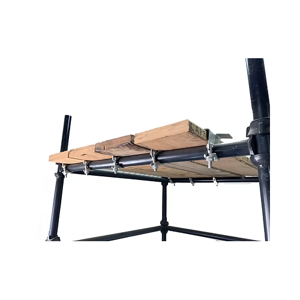
- •Working platform assembly (all regions): Putlog couplers carry the transoms that support scaffold boards; board retaining couplers and BRC clamps stop those boards lifting in wind or under foot traffic
- •Safe ladder access (all regions): Ladder clamps fix access ladders to scaffold tubes so they cannot shift laterally - a mandatory item on any inspected and tagged scaffold
- •Mobile towers and light access (Jeddah, Riyadh): Locking clamps and metal clips secure the frames and platforms on aluminum scaffolding towers used for interior fit-out and facility maintenance
Types of Scaffolding Clamp Available in KSA
Eight distinct scaffolding clamp types are stocked across Saudi suppliers, each engineered for one connection geometry and one load case. Scaffolding clamp types are not interchangeable - a putlog coupler will physically fit where a right-angle coupler belongs, and it will fail under the load that connection was designed to carry.
Right-Angle and Fixed Scaffolding Clamps for 90-Degree Tube Connections
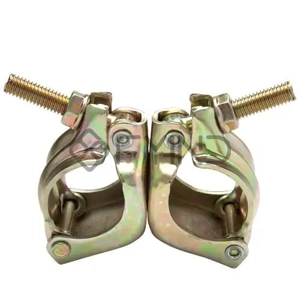
Also called double couplers. The primary load-bearing fitting in any tube-and-coupler scaffold, connecting two 48.3 mm tubes crossing at a rigid 90 degrees. EN 74-1 defines right-angle couplers specifically for tubes crossing at a right angle - this is the connection that carries vertical load from ledger into standard.
- •Tube compatibility: 48.3 mm OD, minimum 3.2 mm wall thickness per EN 74 scope
- •Construction: Drop-forged from Q235-class carbon steel bar with grade 8.8 high-strength bolts, or pressed from steel plate for lighter duty
- •Typical weight: Around 0.98 kg per piece for a British-type electro-galvanized forged double coupler at 48.3 × 48.3 mm
- •Products in KSA: Scaffolding Fixed Coupler (Forged) Right Angle Clamp, Universal Clamps (Fixed / Right-Angle Couplers), Forged Scaffolding Clamp, High-Strength Scaffold Clamps, Scaffolding Clamps British Type For 1-3/4" to 1-9/10"
- •Best suited for: Connecting scaffold tubes at 90° to form standard tube-and-coupler scaffold structures across Saudi construction and industrial sites
Swivel Scaffolding Clamps for Diagonal Bracing and Angled Tube Connections
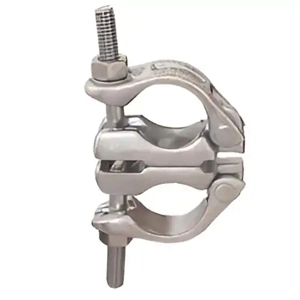
A Scaffolding Swivel Clamp uses a rotating central rivet that lets the two halves turn through a full 360°, connecting tubes at any oblique angle. Every scaffold needs both types: right-angle couplers build the rectangular frame, and the Swivel Clamp takes the diagonal bracing that stops that frame racking sideways. A structure built without swivel-braced diagonals is not a scaffold, it is a stack of rectangles.
- •Rotation: 360° swivel joint on a central rivet, allowing any angle between the two tubes
- •Types available: Drop-forged British type, pressed steel British type, and German type in 48.3 mm; also half-coupler variants
- •Standards: EN 74-1 and BS 1139, in the same Class A / Class B structure as right-angle couplers
- •Products in KSA: Swivel Scaffolding Clamp, Mild Steel Scaffolding Swivel Clamp 15 mm
- •Best suited for: Connecting scaffold tubes at different angles, particularly diagonal bracing and structures where a fixed 90° connection isn't suitable
Putlog Couplers for Scaffold Transoms and Working Platforms
Also called single couplers. These join putlogs or transoms to runner tubes so scaffold boards can be laid across them. The critical point buyers miss: a putlog coupler is not a load-bearing fitting under EN 74. It positions a transom; it does not transfer structural load between standards. Using one in a load path is a scaffold failure waiting to happen.
- •Function: Non-load-bearing positioning fitting for transoms and putlogs
- •Construction: Usually pressed steel - lighter and lower cost than a forged double coupler, appropriate because the duty is lighter
- •Related products in KSA: 40×40 MM Mild Steel Scaffolding Pipe Clamp, Movable Scaffolding Clamp, Truss Scaffolding Clamp
- •Best suited for: Connecting putlogs or transoms to scaffold ledgers so that scaffold boards or platforms can be supported
Sleeve Couplers for Extending Scaffold Tubes End-to-End
An external fitting that slides over the ends of two tubes to join them in line, extending a run beyond the standard 6 m tube length. Sleeve couplers sit outside the tube, unlike joint pins which sit inside - and for load-bearing standards, the external sleeve coupler is the specified fitting because it transfers bending as well as compression.
- •Tube compatibility: 48.3 mm OD, supplied to EN 74-1 Class B standard
- •Construction: Drop-forged and pressed steel versions both available, galvanized finish
- •Positioning rule: Stagger sleeve joints in adjacent standards so multiple splices never occur at the same lift height
- •Products in KSA: Scaffolding Sleeve Clamp
- •Best suited for: Joining two scaffold tubes end-to-end when a longer continuous tube is required
Girder Couplers and Beam Clamps for Steel Beam Connections
A Beam / Girder Clamp attaches scaffolding structures safely to steel H-beams or girders, clamping onto the flange rather than requiring a ground-bearing base. On Saudi industrial plants and refinery structures - where the floor below may be occupied, inaccessible, or simply not there - the girder coupler is what makes a suspended or hung scaffold possible at all.
- •Fixing method: Clamps to the beam flange; usually installed in pairs to carry a tube between two beams
- •Design check required: Flange thickness and beam capacity must be confirmed by the temporary works designer before a hung scaffold is loaded
- •Related products in KSA: Industrial Scaffolding Clamps, High-Strength Scaffold Clamps
- •Best suited for: Connecting scaffold tubes to the flanges of steel beams or girders on plant, refinery and structural steel projects
Board Clamps and Board Retaining Couplers (BRC) for Securing Scaffold Platforms
A Board Retaining Coupler secures scaffolding planks and boards to the framework so they cannot lift or slide. On an exposed Saudi facade scaffold, wind uplift on an unsecured board is a genuine falling-object hazard - the BRC clamp is a low-cost fitting that removes it.
- •Function: Non-load-bearing retention fitting - holds boards and toe boards, does not transfer structural load
- •Construction: Pressed mild steel, galvanized
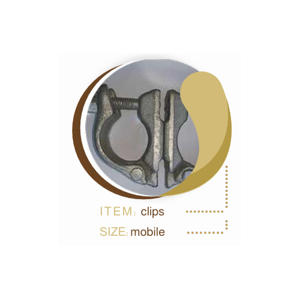
- •Products in KSA: Mild Steel Scaffolding Brc Clamp, 4Pcs Locking Scaffold Clamp, Metal Scaffolding Mobile Clips
- •Best suited for: Securing scaffold boards, planks and toe boards to prevent movement on working platforms
Ladder Clamps for Securing Ladders to Scaffolding
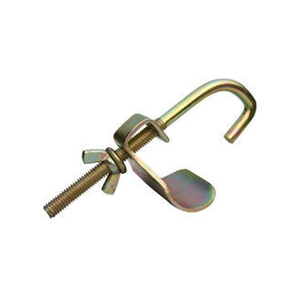
Ladder couplers are manufactured specifically for connecting scaffold tubes with ladders, fixing the stile so the ladder cannot slide laterally or lift at the top. On any scaffold that will be inspected and tagged in Saudi Arabia, tied ladder access is not optional - and lashing a ladder with rope is not an acceptable substitute for a proper clamp.
- •Types: J-hook type, pressed steel type, drop-forged type and double-sided ladder clamps
- •Compatibility: Fits steel and aluminium ladders to 48.3 mm scaffold tubes; confirm the stile section before ordering for aluminium ladders
- •Standards: Pressed and forged ladder clamps are produced to BS 1139 and EN 74
- •Products in KSA: J hook Type Mild Steel Scaffolding Ladder Clamp
- •Best suited for: Connecting and securing ladders to scaffold tubes for compliant, tagged access
Forged, Pressed and Galvanized Scaffolding Clamps for Different Construction Requirements
This is a manufacturing-method distinction rather than a geometry one, and it is where most of the price difference in a KSA clamp quotation comes from. Two clamps can look identical, fit the same tube, and differ by 3× in price and load rating because one is drop-forged and the other pressed.
- •Drop Forged Scaffolding Clamp: Forged from heated Q235-class round steel bar with grade 8.8 bolts. The heaviest and highest load-capacity option - specified for high-rise, heavy-duty industrial and critical structural connections
- •Pressed Scaffolding Clamp: Formed and shaped from high-strength steel plate. Lighter and more economical, and still meets EN 74 / BS 1139 - used most on lighter tubular systems with 3.2 mm or thinner tube wall
- •Cast iron clamps: Lower cost again, but brittle under shock loading compared with forged steel - check the intended duty before substituting
- •Galvanized Scaffolding Clamp: Surface treatment, not a clamp type. Hot-dip galvanizing gives a far thicker coating than electro-galvanizing and lasts significantly longer in Saudi coastal humidity - specify hot-dip for Dammam, Jubail, Yanbu and Jeddah outdoor storage
- •Stainless steel (SS-304): The premium corrosion option where even galvanizing is insufficient - chemical plant, marine and offshore exposure
- •Products in KSA: Forged Scaffolding Clamp, Cast Iron Round Scaffolding Clamp, Round Golden Scaffolding Fix Clamp, Stainless Steel Scaffolding Clamp - SS-304 Grade, 6 mm Mild Steel Scaffolding Rapid Clamp, Sacffolding Construction Rapid Clamp, Scafo Scaffolding Rapid Clamps
Scaffolding Clamp Specifications - KSA Product Comparison
Q: Which scaffolding clamp should I order - forged, pressed, galvanized or stainless?
Decide on two axes. Load: drop-forged for load-bearing right-angle and swivel connections on high-rise and heavy industrial work; pressed steel for putlog, board retaining and lighter-duty positioning fittings. Environment: hot-dip galvanized as the Saudi default for outdoor and coastal sites, SS-304 stainless for chemical and marine exposure, electro-galvanized only for indoor or short-duration use. Ordering "scaffolding clamps" without stating both is how sites end up with corroded pressed fittings in a load path.
| Product | Clamp Function | Material / Method | Load Bearing | KSA Use |
|---|---|---|---|---|
| Scaffolding Fixed Coupler (Forged) Right Angle Clamp | Right-angle / double | Drop-forged steel | Yes - EN 74 | Standard-to-ledger on high-rise scaffolds |
| Universal Clamps (Fixed / Right-Angle Couplers) | Right-angle / double | Forged or pressed steel | Yes - EN 74 | General tube-and-fitting scaffold assembly |
| Forged Scaffolding Clamp | Right-angle load-bearing | Drop-forged Q235-class steel, 8.8 bolt | Yes - highest capacity | Heavy industrial and critical connections |
| High-Strength Scaffold Clamps | Right-angle / girder | Forged steel, high-tensile bolt | Yes - EN 74 Class B duty | Refinery, plant and beam-hung scaffolds |
| Industrial Scaffolding Clamps | Mixed structural range | Forged / galvanized steel | Yes | Oil, gas and petrochemical plant access |
| Scaffolding Clamps, British Type, For 1-3/4" to 1-9/10" | Right-angle, British pattern | Pressed or forged steel | Yes - BS 1139 | Imperial-sized tube ranges, 44.5-48.3 mm |
| Swivel Scaffolding Clamp | Swivel - any angle | Forged or pressed, 360° rivet joint | Yes - EN 74 | Diagonal bracing on facade scaffolds |
| Mild Steel Scaffolding Swivel Clamp 15 mm | Swivel - any angle | Mild steel, 15 mm bolt size | Yes | Angled bracing and raker connections |
| Scaffolding Sleeve Clamp | Sleeve - end-to-end | Forged or pressed, galvanized | Yes - EN 74-1 Class B | Extending standards above 6 m tube length |
| Stainless Steel Scaffolding Clamp - SS-304 Grade | Right-angle / swivel | SS-304 stainless steel | Yes | Chemical, marine and offshore exposure |
| J hook Type Mild Steel Scaffolding Ladder Clamp | Ladder retention | Mild steel, J-hook pattern | No - positioning | Tying access ladders to scaffold tubes |
| Mild Steel Scaffolding Brc Clamp | Board retaining | Pressed mild steel | No - retention | Stopping board uplift on exposed platforms |
| 40×40 MM Mild Steel Scaffolding Pipe Clamp | Pipe / tube fixing | Mild steel, 40×40 mm | Light duty | Square-section and 40 mm pipe connections |
| Truss Scaffolding Clamp | Truss / lattice fixing | Steel | Yes | Truss and lattice beam connections |
| Cast Iron Round Scaffolding Clamp | Round tube fixing | Cast iron | Light to medium duty | Economy option for low-rise and temporary work |
| Round Golden Scaffolding Fix Clamp | Fixed round clamp | Steel, gold zinc-passivated finish | Yes | General fixed connections with corrosion finish |
| 6 mm Mild Steel Scaffolding Rapid Clamp | Rapid / quick-fit | Mild steel, 6 mm | Light duty | Fast assembly on repetitive frame work |
| Sacffolding Construction Rapid Clamp | Rapid / quick-fit | Steel | Light duty | High-turnover site erection and striking |
| Scafo Scaffolding Rapid Clamps | Rapid / quick-fit | Steel, Scafo pattern | Light duty | Speed-critical erection and dismantling |
| Movable Scaffolding Clamp | Adjustable / repositionable | Steel | Light duty | Temporary and frequently repositioned rigs |
| 4Pcs Locking Scaffold Clamp | Locking clip set | Steel, 4 pcs pack | No - locking | Securing mobile tower frames against uplift |
| Metal Scaffolding Mobile Clips | Frame retention clip | Pressed metal | No - retention | Aluminum scaffolding towers and mobile access |
Certifications, Standards and Compliance for Scaffolding Clamps in Saudi Arabia
Manufacturers normally produce scaffolding couplers to recognised safety standards - ask which ones, in writing, before you order.
- •EN 74 - Scaffolding Couplers Standard: The European standard governing couplers, loose spigots and baseplates for steel tubes of 48.3 mm outside diameter and minimum 3.2 mm wall thickness. It divides couplers into Class A, setting basic criteria for slip resistance, distortion and structural integrity, and Class B, which imposes stricter distortion and slip requirements for heavy-duty construction with higher load demands. If your temporary works design specifies Class B, a Class A coupler is not a substitute.
- •BS 1139 - British Standard for Metal Scaffolding: Specifies requirements for prefabricated access scaffolds including drop-forged double couplers, pressed double couplers, swivel couplers, sleeve couplers and putlog couplers. Widely used across the Gulf and often harmonised with EN 74 in supplier documentation.
- •ISO 9001 - Quality Management System: A process certification for the manufacturer, not a product load rating. It tells you the factory has documented, audited production control - useful, but not a substitute for EN 74 test evidence on the coupler itself.
- •CE Certification - European Conformity: Declares conformity with applicable European directives for products placed on the EEA market; frequently cited in Gulf tenders as supporting evidence of compliance.
- •Saudi Aramco and client-specific approval: Large Saudi industrial clients maintain their own vendor approval and material specification regimes on top of EN and BS standards. Confirm at enquiry stage whether your project requires third-party test certificates for the specific coupler batch, not just a generic standards claim.
Real Scaffolding Clamp Problems on KSA Sites - and How to Fix Them
Couplers Slipping Under Load - Bolts Tightened by Feel Instead of Torque
A Riyadh scaffold crew erects a facade rig and the ledgers creep downward at the connections over the following days. The couplers were tightened by hand with a podger spanner and no torque check - some are under-tightened and slipping, others over-tightened and distorted, which permanently reduces their grip.
Fix: Slip resistance is the property EN 74 actually tests, and it depends entirely on correct bolt torque. Issue calibrated torque tools, train the crew to the coupler manufacturer's stated tightening torque, and reject any coupler with a rounded or damaged nut. When ordering, ask the supplier for the EN 74 class and the specified tightening torque in writing - Al Sandan New Factory for Steel Industries (Riyadh) manufactures forged and high-strength clamps and holds ISO 9001 certification, and can confirm class and torque data at enquiry stage.
Coupler Threads Seizing and Bodies Corroding - Electro-Galvanized Fittings in Gulf Coastal Humidity
A Dammam contractor stores couplers outdoors between projects. Within one season the electro-galvanized coating has broken down, bolt threads are seized solid, and crews are cutting fittings off the tubes during dismantling instead of releasing them.
Fix: Coastal Saudi humidity is far harsher on scaffolding fittings than inland conditions. Specify hot-dip galvanized rather than electro-galvanized for anything stored or used outdoors in Dammam, Jubail, Yanbu and Jeddah - the coating is substantially thicker and lasts considerably longer in field conditions. Store couplers in ventilated stillages off the ground, and oil the threads before storage. For chemical plant and marine exposure, step up to SS-304 stainless. Yaqoot Arabia Trading Company (YATCO) in Dammam supplies galvanized and stainless scaffolding fittings for exactly these Eastern Province conditions.
Putlog Couplers Used in a Load Path - The Substitution That Causes Collapses
A storeman runs out of right-angle couplers mid-lift and issues putlog couplers instead because they fit the same 48.3 mm tube and are visually similar. The scaffold is loaded with materials, and the single couplers - which are not rated to transfer structural load - begin to deform.
Fix: Physically separate load-bearing and non-load-bearing fittings in the store, and colour-code or label the stillages. Right-angle and swivel couplers are structural; putlog, board retaining and ladder clamps are not. Order the correct proportions up front from the temporary works design rather than substituting on site. Durar Masagh Trading Company (Riyadh) carries British-type, BRC and pipe clamp ranges together, so the full mix can be specified line by line on a single purchase order.
Second-Hand Couplers Bought to Save Cost - Distorted Jaws With No Remaining Load Rating
A contractor sourcing used scaffolding clamp stock in KSA receives a mixed pallet of fittings from several previous projects. A proportion have splayed jaws, elongated rivet holes and stretched bolts - all invisible until the coupler is on the tube and refuses to close square.
Fix: A distorted coupler has no certified load rating, regardless of what class it was manufactured to. Inspect every second-hand fitting: jaws must close parallel, the rivet must be tight with no play, the bolt must run freely on a full thread, and there must be no cracking at the forging radius. Reject anything that fails. On safety-critical structural connections the cost gap between used and new couplers rarely justifies the risk - Al Sandan New Factory for Steel Industries (Riyadh) and Jumanah Al Banaa For Trading Company (Riyadh) both supply new clamp stock for Riyadh projects.
Clamps Ordered That Don't Match the Tube - Imperial British Type Against Metric 48.3 mm Stock
A Jeddah project orders British-type clamps sized for 1-3/4" to 1-9/10" tube, but the site is running metric 48.3 mm tube alongside Japanese-standard 48.6 mm pipe from a second supplier. Some fittings grip correctly, others sit loose on the larger diameter.
Fix: Confirm the actual outside diameter of the tube on site before ordering, not the nominal description. EN 74 and BS 1139 fittings are built for 48.3 mm OD; JIS-standard couplers are built for 48.6 mm; British imperial ranges cover roughly 44.5-48.3 mm. Never mix tube standards within one scaffold. Ascend Access Global Scaffolding Company (Jeddah) supplies clamps and clips for its own aluminum scaffolding towers and access systems, where matched components remove this risk entirely.
Scaffolding Clamp Suppliers in Saudi Arabia - Verified Manufacturers & Suppliers
Five stocked suppliers across Riyadh, Jeddah and Dammam with actual products and specifications.
Riyadh · Steel Manufacturer Since 1995 · ISO 9001 Certified
Al Sandan New Factory for Steel Industries - Forged & High-Strength Scaffolding Clamp Manufacturer, Riyadh KSA
- •Products: Forged Scaffolding Clamp, Scaffolding Fixed Coupler (Forged) Right Angle Clamp, Universal Clamps (Fixed / Right-Angle Couplers), High-Strength Scaffold Clamps, Industrial Scaffolding Clamps
- •Clamp Types: The load-bearing structural end of the range - drop-forged right-angle and universal couplers plus high-strength and industrial-grade clamps for the connections that actually carry the scaffold's load.
- •Manufacturing capability: Manufactures scaffolding, shuttering and steel accessories to relevant codes with advanced machinery and dedicated production lines; product range extends to cup-lock systems, wall and column formwork, access frames and props.
- •Certification & services: Established 1995; granted ISO 9001 certification in 2008. Provides a certified team of scaffolders and supervisors to erect and dismantle scaffolds in compliance with TUV safety standards, plus specialised inspectors who inspect scaffolding and formwork erection against approved designs and handle site labour training and tagging.
- •Business type: Manufacturer - scaffolding and formwork steel industries
- •Location: Al Mashael, Riyadh, KSA | Phone: +966 50 051 9128
Best for: Main contractors and scaffolding companies in Riyadh, Saudi Arabia that need forged load-bearing couplers backed by an actual factory and a documented quality system - and the only supplier here that also fields certified scaffolders, supervisors and inspectors, which matters when the clamp order sits inside a wider erection, inspection and tagging scope rather than a straight material supply.
Dammam · Construction & Oil Field Stockist · Swivel Clamp Supplier in Dammam
Yaqoot Arabia Trading Company (yatco) - Swivel, Sleeve & Stainless Scaffolding Clamp Supplier, Dammam KSA
- •Products: Swivel Scaffolding Clamp, Mild Steel Scaffolding Swivel Clamp 15 mm, Scaffolding Sleeve Clamp, Stainless Steel Scaffolding Clamp - SS-304 Grade, J hook Type Mild Steel Scaffolding Ladder Clamp
- •Clamp Types: The angled-connection and corrosion-critical end of the range - 360° Swivel Clamp fittings for diagonal bracing, external sleeve couplers for extending standards, SS-304 stainless clamps for aggressive environments, and J-hook ladder clamps for tied access.
- •Wider portfolio: Describes itself as a premier stockist in Saudi Arabia for construction and oil field requirements - scaffolding tubes, Cuplock scaffolding systems, scaffolding accessories, LVL OSHA-compliant scaffold boards, plywood, timber, aluminium ladders and electrical and mechanical materials.
- •Services: Also offers scaffolding erection and rental with experienced specialists for installing and dismantling scaffolding structures - relevant if you want material and labour from one contract.
- •Business type: Stockist, supplier and scaffolding services provider
- •Location: Abu Bakr Al Razi Street, near Dhahran Jubail Highway, Dallah Industrial (Al Khair Industrial), Dammam, KSA | Phone: +966 56 573 1662
Best for: Eastern Province and oil-and-gas buyers who need corrosion-rated fittings for the Gulf coastal atmosphere. Its position on the Dhahran-Jubail corridor and its oil field product focus make it the natural Swivel Clamp Supplier in Dammam for refinery and petrochemical shutdown work, where SS-304 and galvanized fittings are specified rather than preferred - and where tubes, boards and clamps can be drawn from one stock holding.
Riyadh · Building Materials, Safety & Industrial Equipment · Widest Clamp Mix
Durar Masagh Trading Company - British Type, BRC & Pipe Clamp Supplier, Riyadh KSA
- •Products: Scaffolding Clamps, British Type, For 1-3/4" to 1-9/10", Mild Steel Scaffolding Brc Clamp, 40×40 MM Mild Steel Scaffolding Pipe Clamp, Cast Iron Round Scaffolding Clamp, Round Golden Scaffolding Fix Clamp, Truss Scaffolding Clamp
- •Clamp Types: The broadest single mix on this page - British-pattern right-angle clamps sized for imperial tube, board retaining (BRC) clamps, 40×40 mm pipe clamps, truss clamps, and cast iron and gold-finish round clamps as economy options.
- •Company background: Described as one of the leading and pioneer building materials, safety and industrial equipment suppliers in the Kingdom, with substantial experience in the design, manufacture and supply of scaffolding and formwork products across a wide range.
- •Business type: Building materials supplier, safety and industrial equipment distributor, with in-house scaffolding and formwork design and manufacturing experience
- •Location: Al Madina Al Munawwarah Road, Al Faruq, Riyadh, KSA | Phone: +966 11 471 3334 | Mobile: +966 59 445 9172
Best for: Buyers who need the full clamp mix - structural, retention and pipe fittings - line-itemised on one purchase order rather than split across three vendors, which is exactly what prevents the on-site substitution of a putlog or BRC clamp into a load path. The combined building materials and safety equipment catalogue also lets clamps, boards and PPE be consolidated for a Riyadh project.
Riyadh · Al Sinaiyah Industrial District · Rapid Clamp Specialist
Jumanah Al Banaa For Trading Company - Rapid & Movable Scaffolding Clamp Supplier, Riyadh KSA
- •Products: 6 mm Mild Steel Scaffolding Rapid Clamp, Sacffolding Construction Rapid Clamp, Scafo Scaffolding Rapid Clamps, Movable Scaffolding Clamp
- •Clamp Types: The quick-fit end of the market - rapid clamps in 6 mm mild steel and the Scafo pattern, plus movable clamps for rigs that get repositioned rather than struck and rebuilt.
- •Where rapid clamps earn their place: On repetitive, high-turnover erection where labour hours dominate the cost, a faster-fitting clamp pays for itself in assembly time. They are a light-duty fitting - confirm the duty rating against the temporary works design before using them anywhere in a structural load path.
- •Business type: Trading company - construction and scaffolding materials
- •Location: Al Sinaiyah, Riyadh, KSA - the capital's industrial supply district | Phone: +966 55 056 0211
Best for: Riyadh contractors and scaffolding crews running repeat erection cycles - interior fit-out, maintenance access and short-duration rigs - where speed of assembly and dismantling drives the programme more than peak load capacity. Its Al Sinaiyah location puts it in the same trade district as other material suppliers, which suits buyers who want to compare stock in person before committing.
Jeddah · Modon Industrial Area 3 · Aluminum Scaffolding Tower Manufacturer
Ascend Access Global Scaffolding Company - Locking Clamp & Mobile Clip Supplier, Jeddah KSA
- •Products: 4Pcs Locking Scaffold Clamp, Metal Scaffolding Mobile Clips
- •Clamp Types: System-matched retention fittings rather than generic tube couplers - locking clamps supplied in 4-piece sets and pressed metal clips that secure frames and platforms on mobile aluminum scaffolding towers.
- •Access system range: Mobile access towers, aluminium and fiberglass ladders, and customised height-access systems in platform heights from 1.0 m upward across 80×210, 141×210 and 140×255 cm frame widths. Fiberglass options are non-conductive for electrical work and corrosion-resistant for offshore, marine and chemically aggressive settings.
- •Certification: The Ascend group is positioned as a BS EN-certified ladder and scaffolding manufacturer in the GCC, with products tested against British and European Norms, and a regional presence spanning Saudi Arabia, UAE, Qatar, Oman, Bahrain and Kuwait.
- •Business type: Manufacturer and supplier - access systems and aluminium scaffolding
- •Location: Modon Industrial Area 3, Jeddah, KSA | Phone: +966 50 265 0111
Best for: Facility maintenance teams and fit-out contractors who want to buy aluminum scaffolding as a complete matched system rather than assembling one from loose tube and fittings. Because the clips and locking clamps are made for the manufacturer's own towers, the tube-diameter and standards-mismatch problems that affect generic coupler purchasing simply do not arise - and it is the only supplier here operating from Jeddah and the Western Region.
How to Specify the Right Scaffolding Clamp for KSA Projects
Six things to confirm before ordering any scaffolding clamp in KSA:
- ✓Measure the tube, don't trust the description. EN 74 and BS 1139 fittings are built for 48.3 mm OD with a minimum 3.2 mm wall; JIS couplers are built for 48.6 mm; British imperial ranges span roughly 44.5-48.3 mm. Never mix tube standards within one scaffold, and state the measured OD on the purchase order.
- ✓Separate load-bearing from non-load-bearing on the order. Right-angle and swivel couplers are structural. Putlog, board retaining and ladder clamps are not. Take the quantities from the temporary works design so the store never has to substitute mid-lift.
- ✓State the EN 74 class, not just "EN 74 compliant". Class A covers basic slip resistance, distortion and structural integrity; Class B imposes stricter distortion limits for heavy-duty, higher-load construction. If the design calls for Class B, a Class A coupler will not do.
- ✓Match the finish to the Saudi region, not the price list. Hot-dip galvanized for outdoor and coastal use in Dammam, Jubail, Yanbu and Jeddah; SS-304 stainless for chemical, marine and offshore exposure; electro-galvanized only for indoor or short-duration work inland.
- ✓Ask for the tightening torque and issue calibrated tools. Slip resistance is the property EN 74 tests, and it is entirely dependent on correct bolt torque. Under-tightening lets the coupler slip; over-tightening distorts the jaws and permanently reduces grip.
- ✓Get the HS code and test documentation agreed before shipment. Scaffolding clamps and couplers of iron or steel classify under HS heading 7308.40 - equipment for scaffolding, shuttering, propping or pit-propping - with Saudi Customs applying it through the GCC Common Customs Tariff's extended national coding. Confirm whether your client requires batch test certificates alongside the standards claim.
FAQs - Scaffolding Clamps in KSA
What are the types of scaffolding clamps?
The main scaffolding clamp types are the right angle (fixed) coupler, which connects two tubes at a rigid 90-degree angle; the swivel coupler, which connects tubes at any varied or oblique angle and is mainly used for bracing; the single or putlog coupler, used to join putlogs or transoms to runner tubes; the board retaining coupler (BRC), which secures scaffolding planks and boards to the framework; and the beam or girder clamp, which attaches scaffolding structures safely to steel H-beams or girders. Sleeve couplers and ladder clamps complete the standard range.
Where can I find scaffolding in Saudi Arabia?
Scaffolding suppliers in Saudi Arabia cluster around the three main industrial regions. In Riyadh: Al Sandan New Factory for Steel Industries (Al Mashael), Durar Masagh Trading Company (Al Madina Al Munawwarah Road) and Jumanah Al Banaa For Trading Company (Al Sinaiyah). In the Eastern Province: Yaqoot Arabia Trading Company (YATCO) in Dammam's Dallah Industrial area. In the Western Region: Ascend Access Global Scaffolding Company at Modon Industrial Area 3, Jeddah. Contact details for each are listed in the supplier section above.
How many types of scaffolding are there in Saudi Aramco?
Saudi Aramco applies its own engineering standards and approved-vendor regime to scaffolding on its facilities, so the authoritative list is whatever appears in the current Aramco standard for your project - request it through your contract rather than relying on a general reference. In broad industry terms, the systems commonly used on Saudi industrial sites are tube-and-coupler (tube-and-fitting) scaffolds, Cuplock, Kwikstage and Ringlock modular systems, H-frame or facade frame scaffolds, suspended scaffolds and mobile aluminium towers. Tube-and-coupler is the system that depends on the scaffolding clamps covered on this page.
What is the average salary for a scaffolder in Saudi Arabia?
Scaffolder pay in Saudi Arabia varies widely with certification level, employer and sector - a certified scaffolder or supervisor working an Aramco-standard petrochemical shutdown is on a different rate to a general labourer on a residential site, and packages often include accommodation and transport that change the comparison. Because published figures move quickly and differ by source, check a current salary survey or recruitment listing rather than relying on a single quoted average. From a procurement point of view, the relevant consequence is that erection labour is a significant share of scaffold cost, which is why faster-fitting clamps and matched system components affect a project budget as much as the unit price of the fittings themselves.
What is the scaffolding clamp price in Saudi Arabia?
Scaffolding clamp price in KSA is driven by four variables rather than one: manufacturing method (drop-forged costs substantially more than pressed steel), material (SS-304 stainless sits well above galvanized mild steel), surface finish (hot-dip galvanizing costs more than electro-galvanizing and lasts far longer), and order quantity. Because couplers are ordered in thousands on a large scaffold, ask every supplier for tiered quantity pricing and confirm the EN 74 class at the same time - a cheaper unit price against a lower class is not a saving. Contact the suppliers listed above for current project pricing.
What is the scaffolding clamp HSN code?
Scaffolding clamps, couplers and fittings of iron or steel fall under HS / HSN heading 7308.40 - "Equipment for scaffolding, shuttering, propping or pit-propping" - within Chapter 73 (articles of iron or steel). Scaffold couplers and fittings are expressly among the goods classified here, alongside scaffold frames, adjustable props and formwork support components. Saudi Customs applies this heading through the GCC Common Customs Tariff's extended national coding, so confirm the full national code with your supplier or customs broker before shipment.
Drop forged or pressed steel scaffolding clamp - which should I buy?
Drop-forged clamps are forged from heated carbon steel bar with grade 8.8 bolts and are the heaviest, highest load-capacity option - specify them for load-bearing right-angle and swivel connections on high-rise, heavy industrial and critical structural work. Pressed steel clamps are formed from steel plate, are lighter and more economical, and still meet EN 74 and BS 1139 - they suit lighter tubular systems and non-load-bearing duties such as putlog, board retaining and ladder fittings. The decision is duty-driven: use forged where the connection carries load, pressed where it positions a component.
Why do I need galvanized scaffolding clamps in Saudi Arabia?
Because Gulf coastal humidity destroys unprotected steel fittings quickly. Galvanizing is a surface treatment applied to any clamp type, and the two grades behave very differently in Saudi field conditions: hot-dip galvanizing produces a substantially thicker coating than electro-galvanizing and lasts far longer outdoors. For Dammam, Jubail, Yanbu and Jeddah - and for any fittings stored outside between projects - specify hot-dip. Where even galvanizing is insufficient, such as chemical plant or offshore exposure, SS-304 stainless clamps are the next step up.
Should I buy used scaffolding clamps in KSA?
Only after inspection, and never for safety-critical structural connections without one. A used coupler with splayed jaws, an elongated or loose rivet, a stretched bolt or cracking at the forging radius has no certified load rating regardless of the class it was originally made to, and the damage is often invisible until the fitting is on the tube. Check that jaws close parallel, the rivet is tight with no play, and the bolt runs freely on a full thread. On load-bearing connections the price gap between used and new rarely justifies the risk.
Can I buy aluminum scaffolding and clamps from the same supplier?
Yes, and for mobile tower work it is the better route. Aluminum scaffolding towers use system-matched locking clamps and clips rather than generic tube couplers, so buying the tower and its fittings together removes any tube-diameter or standards mismatch. Ascend Access Global Scaffolding Company in Jeddah manufactures mobile access towers, aluminium and fiberglass ladders and the matched clips and locking clamps that go with them. For tube-and-fitting scaffolds, by contrast, tubes and couplers are commonly sourced separately - in which case the measured tube OD must be confirmed before the clamps are ordered.
Who are the leading Scaffolding Clamp suppliers in KSA?
Based on product range, manufacturing capability and regional coverage, the Scaffolding Clamp suppliers in Saudi Arabia listed here are Al Sandan New Factory for Steel Industries (Riyadh - forged and high-strength clamps, ISO 9001, certified scaffolders and inspectors), Durar Masagh Trading Company (Riyadh - widest clamp mix including British type, BRC and pipe clamps), Jumanah Al Banaa For Trading Company (Riyadh - rapid and movable clamps), Yaqoot Arabia Trading Company (yatco) (Dammam - swivel, sleeve and SS-304 stainless clamps) and Ascend Access Global Scaffolding Company (Jeddah - locking clamps and clips for aluminum scaffolding towers). Compare their product lines and contact details above to match a supplier to your clamp type, finish and region.
Related Scaffolding Fittings & Accessories in KSA
- •Scaffolding Tube - The 48.3 mm OD steel tube these clamps are designed to grip; confirm wall thickness against EN 74's 3.2 mm minimum
- •Scaffolding Beam - Horizontal load-carriers spanning between verticals, including H20 timber and steel decking beams
- •Base Jack & U-Head Jack - Adjustable load-bearing bases that level a scaffold on uneven Saudi ground conditions
- •Joint Pin - The internal alternative to a sleeve coupler for joining tubes end to end in non-load-bearing positions
- •Scaffold Board & LVL Plank - The working platform surface that board retaining and BRC clamps secure
- •Cuplock & Ringlock System Components - Modular alternatives to tube-and-fitting where node connectors replace loose couplers
- •Aluminum Scaffolding Tower - Mobile access towers using system-matched clips and locking clamps rather than generic couplers
- •Adjustable Prop - Telescopic steel props classified under the same HS heading 7308.40 as scaffolding clamps
- •Safety Netting & Toe Board - Edge protection components retained on the scaffold by board clamps and clips