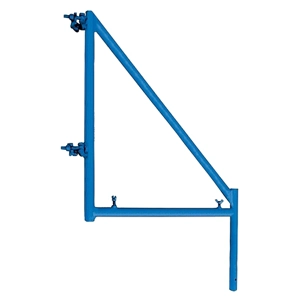
Roll a mobile tower up to a decent working height and its narrow wheelbase becomes the whole problem - a scaffold that's tall relative to its base is a scaffold that wants to tip. A stabilizer, also sold as an outrigger, is the simple triangular bracket that widens that base back out again. It rarely gets a second thought until a site inspector asks where they are. This guide covers the real types of scaffolding stabilizers sold in the UAE, the height-to-base rule that decides whether you legally need them, and what to check before you order.
A mobile scaffold tower is inherently top-heavy once it climbs past a few metres - its wheelbase stays fixed while its working height keeps growing. Most scaffold safety standards apply a simple height-to-base ratio: once a tower's height exceeds roughly 3 to 3.5 times its narrowest base dimension, it needs stabilizers or must be tied to a structure. In the UAE's wind conditions, and especially with debris netting or sheeting fitted (which catches wind like a sail), that ratio gets reached faster than most site teams expect.
A set-length triangular bracket, most common in packaged mobile tower kits sold as a complete unit. Quick to fit and cheaper than an adjustable version, but limited to whatever footprint the fixed length gives you - fine for a standard rectangular open area, less useful in a tight or irregular space.
Pivots on its swivel clamp so the outrigger can be angled in against a wall on one side while the opposite pair extends straight out, rather than needing open floor space on all four sides. This is the practical choice for working against a building façade or in a partially enclosed area.
Extends and locks at intermediate lengths, letting one stabilizer set cover several different footprint requirements rather than needing a separate fixed-length set for every job. The extra flexibility costs more upfront but suits contractors moving between varied site conditions rather than working one fixed layout repeatedly.
Working in open floor space on a standard rectangular tower kit? Fixed outriggers are the simplest, cheapest option. Working right up against a wall or façade where floor space is tight on one side? Adjustable-angle stabilizers, angled parallel to the wall. Moving between multiple sites or layouts with different space constraints? Telescoping stabilizers earn their higher cost through flexibility.
| Specification | What to Look For |
|---|---|
| Material | Steel for heavy-duty frame scaffolds and higher static loads; aluminum for lighter mobile aluminum towers where reduced weight speeds up repositioning |
| Clamp Type | Swivel clamps are standard, letting the outrigger set at the optimal angle (typically around 45°) to the scaffold leg |
| Foot Type | A solid base plate for stationary scaffolds, or a heavy-duty locking castor wheel for mobile towers that need to stay rollable |
| Height-to-Base Ratio | Confirm your tower's actual working height against a roughly 3:1 to 3.5:1 height-to-base rule before deciding stabilizers aren't needed |
| Quantity per Tower | Two stabilizers when working against a wall (one pair extended); four when the tower is free-standing away from any structure |
Sheeted or netted mobile towers catch significantly more wind load than an open frame, which pushes the effective height-to-base ratio limit lower than the bare-frame figure. If a mobile tower has debris netting or sheeting fitted, treat it as needing stabilizers at a lower height than an equivalent unsheeted tower would.
Both steel and aluminium scaffold stabilizers improve tower stability, but the right choice depends on the application, working environment and frequency of use.
| Feature | Steel Stabilizers | Aluminium Stabilizers |
|---|---|---|
| Weight | Heavier | Lightweight and easy to handle |
| Strength | Excellent for heavy-duty industrial scaffolds | Ideal for mobile access towers and light-duty applications |
| Corrosion Resistance | Usually protected by galvanizing or coatings | Naturally corrosion resistant |
| Ease of Transport | Requires more effort to move | Quick to transport and reposition |
| Typical Applications | Construction, infrastructure, industrial maintenance and heavy-duty scaffold systems | Painting, facility maintenance, MEP work, fit-outs and mobile scaffold towers |
Buying Tip: Choose steel stabilizers when maximum strength and durability are required for demanding construction projects. Aluminium stabilizers are better suited for mobile scaffold towers that need to be assembled, dismantled and moved frequently.
Before purchasing scaffold stabilizers, ensure they are compatible with the scaffold tower and meet the relevant safety standards used across UAE construction projects.
| Standard | Why It Matters |
|---|---|
| EN 1004 | European standard for mobile access towers covering stability, guardrails, platform dimensions and the use of outriggers. |
| EN 12810 | Specifies performance requirements for prefabricated façade scaffolding systems used on construction sites. |
| EN 12811 | Defines general performance and design requirements for temporary access and working scaffolds. |
| Dubai Municipality / OSHAD / Local HSE Requirements | Many UAE projects require scaffolding systems and stabilizers to comply with approved safety procedures and manufacturer recommendations. |
Tip: Always verify that the stabilizer is approved for your scaffold tower model and installed according to the manufacturer's instructions. Compliance depends on the complete scaffold system—not the stabilizer alone.
Below are established scaffolding stabilizer suppliers and manufacturers serving Dubai, Sharjah, Abu Dhabi and the Northern Emirates.
Ascend manufactures scaffold access components in-house - frames, guardrails, ladder sections - from their Dubai facility, and stocks the stabilizer brackets that pair with their own frame systems. A practical fit for contractors who want stabilizers guaranteed to clamp cleanly onto Ascend frames rather than sourcing a mismatched brand.
Best For: Stabilizers Matched to Ascend Frame SystemsWhy contractors choose them: buying stabilizers from the same manufacturer as the frame and access system removes any doubt about clamp fit and tube diameter compatibility across mismatched brands.
Al Dereya carries one of the widest mobile aluminum tower ranges among UAE scaffolding traders, and stocks the stabilizer outriggers that pair with those towers as standard safety accessories - a sensible single source when the tower and its stabilizers are being ordered together.
Best For: Stabilizers Bundled With a Mobile Tower OrderWhy contractors choose them: ordering the mobile tower and its stabilizers from one supplier avoids a mismatch between tower leg diameter and stabilizer clamp size that can happen when the two are sourced separately.
Contact hours, exact stock and current pricing vary by supplier - always confirm stabilizer length, clamp size, and foot type against your specific tower model before ordering.
A common shortcut is fitting whatever stabilizer is on hand rather than checking it actually restores the required height-to-base ratio for the specific tower height in use. Fix: calculate the actual ratio needed for the working height and confirm the stabilizer length delivers it, rather than assuming any stabilizer is enough.
A stabilizer clamped loosely or at the wrong angle doesn't deliver the footprint width it's rated for. Fix: confirm the swivel clamp is tightened fully at roughly 45° (or the angle specified by the manufacturer), and check it hasn't slipped during transport or setup.
On uneven ground, a stabilizer's base plate or castor foot can end up not fully bearing weight, which defeats its purpose even if the outrigger itself is correctly angled. Fix: check every stabilizer foot for firm contact on setup, using packing or levelling where the ground isn't flat.
Stabilizers sometimes get temporarily removed to move a tower through a tight gap, then not reinstated before the tower goes back into use. Fix: treat stabilizer reinstatement as a mandatory checklist item before anyone climbs a tower that's been moved.
Indicative per-piece ranges by type - always request a written quote for your exact tower model and quantity.
| Stabilizer Type | Indicative Price (AED, per piece) |
|---|---|
| Fixed Outrigger (Steel) | AED 150 – 280 |
| Fixed Outrigger (Aluminum) | AED 200 – 350 |
| Adjustable-Angle Stabilizer | AED 280 – 450 |
| Telescoping Stabilizer | AED 350 – 550 |
Indicative price ranges for reference only - actual quotes vary by order volume, material, foot type, and the specific supplier.
Most towers need at least two stabilizers and often four, so orders scale quickly across a fleet of mobile towers. Specify the exact tower model, leg diameter, and foot type (castor vs base plate) up front so the supplier can quote an accurate bulk rate.
Inspect scaffold stabilizers before every use and as part of routine scaffold inspections. Even minor damage or loose fittings can reduce stability and increase the risk of overturning.
Never use damaged, bent or modified scaffold stabilizers. Replace defective components immediately to maintain scaffold stability and comply with site safety requirements.
Stabilizers are almost always ordered alongside these related components.
In everyday supplier language these are the same product - a triangular bracket that widens a mobile tower's base footprint. "Outrigger" is the more common technical term; "stabilizer" describes what it does.
Most safety standards apply a height-to-base ratio of roughly 3:1 to 3.5:1 - once your tower's working height exceeds that multiple of its narrowest base dimension, stabilizers or structural ties become necessary. Confirm the exact figure against the standard your project follows and the manufacturer's guidance for your specific tower.
Two stabilizers when the tower is working against a wall, positioned parallel to the wall while the opposite side extends outward. Four stabilizers when the tower is free-standing away from any structure.
Effectively yes. Sheeting and netting significantly increase the wind load a tower catches, which lowers the height at which stabilizers become necessary compared to an equivalent open, unsheeted tower.
It's best avoided unless clamp size and leg diameter are confirmed to match exactly. Sourcing stabilizers from the same manufacturer or supplier as the tower itself removes the risk of a fit mismatch.
A scaffold brace strengthens the scaffold structure by connecting frames or standards, while a scaffold stabilizer (or outrigger) extends the base of a mobile tower to improve balance and prevent tipping. Although both improve safety, they perform different functions.
Stabilizers widen the scaffold's base footprint, reduce the risk of tipping, improve resistance to lateral movement, and increase stability when working at greater heights or in windy outdoor conditions.
Scaffold stabilizers become necessary when a mobile scaffold tower exceeds the manufacturer's recommended height-to-base ratio or when required by standards such as EN 1004. Outdoor use, high winds, debris netting, or uneven ground may require stabilizers even at lower heights.

 0
0