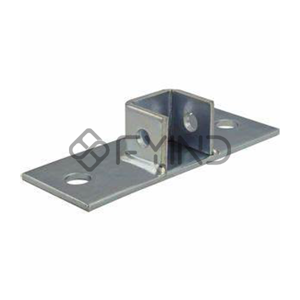

Every standard in a scaffold eventually has to meet the ground - and a scaffolding plate (base plate) is what stops that point load punching straight through a sole board or soft surface. This page compares four verified UAE base plate suppliers, from Dana Group's multi-hole base posts to Ascend's own-branded plates and SinoPro's stem-spigot design, with real specs, finishes, and item codes.
A scaffolding plate is a flat square steel plate with a short vertical spigot (stem) welded to the centre - the standard tube or base jack sits down onto that spigot, and the plate spreads what would otherwise be a concentrated point load across a much wider footprint. Skip it, or use one that's undersized, and a standard can sink straight into asphalt, soft ground, or a poorly rated floor slab under load. Some plates go further, with multiple bolt holes or a gusseted design so the plate can be physically fixed down - useful anywhere wind uplift or repeated foot traffic could shift a plate that's just sitting loose.
|
Q235 Steel
Common Material
|
150 x 150 mm
Typical Plate Size
|
6 mm
Common verified plate thickness
|
1.12 kg
Verified plate weight (Ascend)
|
Q: Isn't a base plate just part of a base jack - why buy it separately?
A base jack has a plate built into its screw mechanism, but a standalone base plate is a simpler, cheaper component used under a plain (non-adjustable) scaffold standard, or as a replacement part when only the plate - not the whole jack - has worn out or bent. If your ground is level and you don't need height adjustment, a plain base plate under a fixed standard is often all you need; an adjustable base plate (base jack) is for uneven ground where height adjustment matters.
Every scaffold standard carries a share of the structure's total weight down to a single point. Without a plate, that entire load would concentrate onto the small diameter of the tube itself - easily enough to punch through soft ground, asphalt in summer heat, or a lightly rated floor slab. A base plate's whole purpose is load distribution: spreading that point load across a much wider footprint (150 x 150 mm on every verified listing on this page) so the pressure per square centimetre on the ground drops to something the surface can actually bear.
This is also where bearing capacity comes in - the maximum load a given ground surface can support per unit area before it deforms or fails. Firm concrete has high bearing capacity and rarely needs anything beyond a standard plate; soft or made-up ground has much lower bearing capacity and often needs a plate plus a timber sole board on top to spread the load even further.
"Sole plate" is sometimes used as another name for the steel base plate itself, which causes confusion with a sole board - a separate timber (or sometimes composite) board laid flat under one or more base plates on soft ground, spreading the load again over an even wider area than the steel plate alone can manage. If a supplier or site foreman says "sole plate," always confirm whether they mean the steel plate under the standard or the timber board underneath that plate - the terms overlap in everyday site language even though they're two different scaffold accessories doing two different jobs.
| Plate Type | Typical Material | Typical Dimensions | Primary Function | Best For |
|---|---|---|---|---|
| Standard Base Plate (with Stem/Spigot) | Mild Steel | 150 x 150 x 6 mm, ~27 mm OD spigot | Spreads point load from the standard across the ground | General scaffold standards on level ground |
| 3-Hole / 4-Hole Base Post | Mild Steel | ~6 mm thickness | Allows the plate to be physically bolted down | Wind-exposed or high-traffic sites needing fixed plates |
| 6-Hole Base Post | Mild Steel | ~6 mm thickness | Maximum fixing points for the most secure bolt-down | Heavy-duty or high-wind installations |
| Gusset Base Post | Mild Steel | ~6 mm thickness | Reinforced gusset bracing adds rigidity at the spigot joint | Higher-load standards needing extra base stiffness |
| Double Channel Base Post | Mild Steel | ~6 mm thickness | Channel profile base for twin-standard or heavier-duty frames | Frame scaffolding and heavier-duty base configurations |
| Adjustable Base Plate (Base Jack) | Mild Steel | 150 x 150 mm plate + threaded screw | Combines load distribution with height adjustment | Uneven ground needing both levelling and a wide footprint |
| Ringlock Base Plate | Mild Steel | ~150 x 150 mm, Ringlock-specific spigot | Matches the Ringlock system's rosette-and-spigot connection | Sites standardized on Ringlock scaffolding |
| Cuplock Base Plate | Mild Steel | ~150 x 150 mm, Cuplock-specific spigot | Matches the Cuplock system's cup-and-blade connection | Sites standardized on Cuplock scaffolding |
| Kwikstage Base Plate | Mild Steel | ~150 x 150 mm, Kwikstage-specific spigot | Matches the Kwikstage system's wedge-lock connection | Sites standardized on Kwikstage scaffolding |
Dimensions marked with a tilde (~) are common industry-typical values for buyer reference alongside the verified specs further down this page. The Ringlock, Cuplock, and Kwikstage rows describe general system-specific plate designs rather than a confirmed product from any of the four suppliers below - ask directly which proprietary system a supplier's base plate is designed for before ordering, since a plate built for one system's spigot won't fit another.
Unlike some scaffold accessories sold as generic, unbranded stock, base plates in this category are frequently produced under a manufacturer's own brand line - worth knowing if your project specification calls for a named, traceable product rather than an anonymous fitting.
Four verified suppliers listed on fyind.com - from a wide multi-hole range to precisely specified single products.
Serves: UAE-wide | View Supplier Profile | Phone: +971 4 221 7273
Dana Group of Companies lists by far the widest base plate range on this page - eight distinct products spanning 3-hole, 4-hole, and 6-hole bolt patterns, a gusset-reinforced design (BTB Gusset Base Post), and two double-channel base posts for heavier-duty or twin-standard configurations. If your project needs to standardize on one brand across multiple base plate types - say, standard 3-hole plates for most standards and gusset plates for a few high-load points - Dana's range covers that from a single supplier rather than mixing brands.
Phone: 04 885 5001 | Location: Nad Al Hamar, Dubai, UAE | View Supplier Profile
Ascend publishes the single most complete specification sheet on this page for one product - exact spigot dimension, base plate size and thickness, weight, shipping volume, and two distinct item codes depending on finish. If you know you want a painted or hot-dip galvanized finish specifically, quoting the exact ASC code back to them (ASC-BPP-01 or ASC-BPHDG-01A) is the fastest way to get an accurate order confirmed.
Serves: UAE-wide Phone: +971 4 880 6686 | View Supplier Profile
China National Building Material Group FZE's listing states a supply capability of 50,000 units under its SinoPro brand - the clearest signal on this page of manufacturing-scale capacity for large, project-wide orders rather than small batch stock. If your project needs base plates in volumes that a general trader might struggle to fulfil quickly, this supply capability figure is worth confirming directly against your required quantity and timeline.
Serves: UAE-wide | Phone: +971 4 589 2 555 | View Supplier Profile
Al Naseeha's base plate matches the same 150 x 150 x 6 mm footprint verified on Ascend's listing, giving you a second directly comparable quote at an identical size - useful for a straightforward price comparison without needing to convert between different dimension sets. Al Naseeha is also already a verified supplier of boards, braces, clamps, jacks, and guardrails covered elsewhere in this series.
| Supplier | Brand | Range | Best For |
|---|---|---|---|
| Dana Group of Companies | Dana | 8 products: 3/4/6-hole, gusset, double channel | Standardizing multiple plate types under one brand |
| Ascend Access Systems Scaffolding LLC | ASC | 150x150x6mm, painted or HDG | Full spec sheet, freight-planning detail |
| China National Building Material Group FZE | SinoPro | Stem-spigot base plate | Large-volume, project-wide orders (50,000 unit capacity) |
| Al Naseeha Building Materials Trading Co LLC | - | 150x150x6mm base plate | Direct comparison against Ascend's identical size |
| Product | Plate Size | Thickness | Weight | Finish | Supplier |
|---|---|---|---|---|---|
| Base Plate | 150 x 150 mm | 6 mm | 1.12 kg | Painted or Hot-Dip Galvanized | Ascend |
| Base Plate 150x150x6mm | 150 x 150 mm | 6 mm | ~1.1 kg | ~Galvanized | Al Naseeha |
| 3/4-Hole Base Post | ~150 x 150 mm | 6 mm | ~1.1–1.3 kg | ~Galvanized | Dana |
| 6-Hole / Gusset / Double Channel Base Post | ~150 x 150 mm | 6 mm | ~1.2–1.6 kg | ~Galvanized | Dana |
| Base Plate With Stem Spigot | ~150 x 150 mm | ~6 mm | ~1.1 kg | ~Galvanized | China National Building Material Group (SinoPro) |
Plain values are stated directly on the supplier's own listing. Values marked with a tilde (~) are common industry-typical figures for buyer reference at that plate size - confirm the exact figure with the supplier before ordering.
| Problem | Why It Happens | Fix |
|---|---|---|
| Plate sinking into soft ground | Undersized plate or soft/uneven ground concentrates load past the surface's bearing capacity | Use a sole board under the plate to spread load further, or step up to a larger plate size |
| Corrosion at the spigot weld | Ground contact and humidity attack the weld joint faster than the flat plate surface | Specify hot-dip galvanized over painted finish for long-term ground-contact use; inspect welds regularly |
| Plate shifting or lifting | A plain plate with no fixing holes relies on weight alone to stay in place | Use a multi-hole or gusset base post and bolt it down on wind-exposed or high-traffic sites |
| Bent or deformed plate | Overloading beyond the plate's rated capacity, or impact damage during handling | Retire and replace - a bent plate no longer spreads load evenly and shouldn't be reused |
The figures below are a general market guide, not a quote from any supplier named on this page. Pricing depends on plate size, thickness, hole pattern, finish, and order volume, and moves with steel costs over time.
| Plate Type | Typical AED Range (per piece) | What Moves the Price |
|---|---|---|
| Standard base plate (with spigot) | AED 15 – 30 | Thickness, painted vs galvanized finish |
| 3/4-hole base post | AED 20 – 40 | Bolt hole count and thickness |
| 6-hole / gusset / double channel base post | AED 30 – 60 | Reinforcement design and material volume |
Note: these ranges are indicative market pricing for buyer guidance only and are not quotes from any of the four suppliers listed on this page.
It spreads the concentrated point load from a scaffold standard across a wider footprint on the ground, preventing the tube from sinking into or punching through soft ground, asphalt, or a lightly rated floor.
A plain plate is fine on stable, sheltered sites where the plate's own weight keeps it in place. A multi-hole or gusset base post is worth the extra cost on wind-exposed sites, high-traffic areas, or anywhere the plate could realistically shift or lift without being physically bolted down.
Hot-dip galvanized gives a thicker, longer-lasting corrosion-resistant coating, better suited to plates that sit in ground contact or humid conditions long-term. Painted finish is a lower-cost option that suits shorter-term or indoor use where corrosion exposure is limited.
A base plate is a simple, fixed component with no height adjustment, used under a plain standard on level ground. A base jack has a threaded screw mechanism built above its own plate, letting you fine-tune height on uneven ground - pick a base jack when you need adjustment, a plain base plate when you don't.
Not always - on firm, stable ground with good bearing capacity, the base plate alone is often enough. On soft, uneven, or made-up ground, a timber sole board under the plate spreads the load further and is generally required to keep the standard from sinking or tilting.
Yes, provided it passes inspection - flat, not bent or corroded through, with the spigot weld intact and any fixing holes not elongated or torn. A base plate that's visibly deformed, cracked, or heavily corroded should be retired rather than reused, since it can no longer distribute load the way it's meant to.
150 x 150 mm at 6 mm thickness is the size verified across every supplier on this page and covers most general scaffold loads on reasonable ground. Step up to a larger or thicker plate - or add a sole board - where ground bearing capacity is low, loads are unusually high, or the project specifically calls for it.
Yes - an adjustable base jack has its own plate built into the screw mechanism, so it does everything a plain base plate does plus height adjustment. The trade-off is cost: a base jack costs more than an equivalent plain plate, so it's worth reserving for standards that actually need levelling rather than fitting them everywhere by default.
Contact the suppliers above directly with your required plate type, size, thickness, finish, and quantity. Pricing depends on all of those details plus current steel costs, so it isn't something a generic price list can reflect accurately.

 0
0