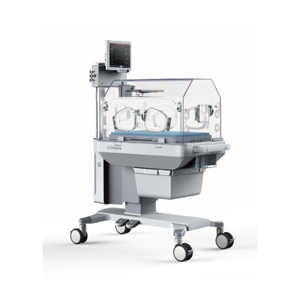

FYIND connects Saudi hospitals, NICUs, IVF laboratories and diagnostic centers with verified medical incubator suppliers across the Kingdom. The listings below cover servo-controlled infant incubators, transport incubators, open warmers, laboratory incubators and IVF incubators, matched to the technical specifications, certifications, budget ranges and delivery timelines that procurement teams evaluate before issuing a purchase order.
Every supplier listed on this page is SFDA-registered for medical device distribution and offers installation, calibration and preventive maintenance support, with competitive quotations available nationwide across Riyadh, Jeddah, Dammam, Qassim and the Eastern Province.
NICU & IVF Equipment · Jeddah, KSA
Attieh Medico is a Jeddah-headquartered medical equipment supplier that has operated in the Saudi healthcare market since 1992. Its product portfolio spans medical imaging, ICU/ER, IVF and laboratory equipment, hospital furniture, and healthcare informatics, with branch offices covering Riyadh, Al Khobar, Abha, Madinah, Tabuk and Qassim. The company maintains an in-house team of biomedical engineers for installation, commissioning and after-sales service.
| Address | Abdullah Ibn Muhammad Al Khulaifi St, Al Nakheel, Jeddah 23242, Saudi Arabia |
| Phone | +966 12 286 4707 |
| Coverage | Jeddah, Riyadh, Al Khobar, Abha, Madinah, Tabuk, Qassim |
| Products Supplied | NICU incubators, open warmers, IVF and laboratory incubators, phototherapy units |
| Delivery Time | 2-4 weeks for in-stock models; 6-10 weeks for special-order units (confirm with supplier) |
| Value-Added Services | Installation, biomedical engineering support, staff training, spare parts |
Why Choose This Supplier: Established national footprint with a dedicated IVF and laboratory equipment line and locally based biomedical engineers for faster service response.
Laboratory & Scientific Equipment · Qassim, KSA
Bloom Medical Company is headquartered in Qassim with additional branch offices in Riyadh and the Northern region. The company is licensed by the Saudi Food and Drug Authority (SFDA) for medical device distribution and importation, and supplies medical, laboratory, educational and scientific equipment sourced from partner manufacturers across Europe, Japan, China and the USA.
| Address | P.O. Box 7989, Buraidah 52382-2948, Qassim, Saudi Arabia |
| Phone | +966 59 047 0728 (Qassim Branch) |
| info@bloom-med-sa.com | |
| Coverage | Qassim, Riyadh, Northern Region |
| Products Supplied | Laboratory incubators, transport incubators, scientific and educational lab equipment |
| Delivery Time | 2-4 weeks for in-stock models; 6-10 weeks for special-order units (confirm with supplier) |
| Certifications | SFDA-licensed (Distribution & Importation) |
Why Choose This Supplier: SFDA-licensed distributor with strong reach into Qassim and the Northern region, useful for hospitals outside the main Riyadh/Jeddah/Dammam corridor.
Hospital Equipment Sourcing · Riyadh, KSA
Saudi Medical Gate is based in the Al Olaya district of Riyadh and sources hospital equipment and clinical supplies for healthcare facilities in the region. Buyers should confirm current product lines, certifications and lead times directly with the supplier, as detailed public information on incubator-specific offerings is limited.
| Address | Al Olaya, Riyadh 11564, Saudi Arabia |
| Phone | +966 11 216 0016 |
| Coverage | Riyadh and surrounding region |
| Products Supplied | Hospital and clinical equipment sourcing, medical incubators (confirm current catalog with supplier) |
| Delivery Time | Confirm current lead time directly with supplier |
Why Choose This Supplier: Riyadh-based sourcing contact for hospitals evaluating multiple equipment categories in one procurement conversation.
National Distributor · Riyadh, KSA
Salehiya Healthcare, established in 1964, is one of Saudi Arabia's longest-operating healthcare distribution companies, with branch offices in Jeddah, Dammam, Khamis Mushait, Qassim and Madinah alongside its Riyadh headquarters. The company distributes pharmaceuticals, medical and laboratory equipment, diagnostics and hospital supplies, and holds WHO Good Distribution Practice (GDP) certification and ISO 13485 for quality management.
| Address | 7057 Hibatullah Al Ghaffari, As Sulimaniyah, Riyadh 12242, Saudi Arabia |
| Phone | +966 92 002 0053 |
| Coverage | Nationwide (Riyadh, Jeddah, Dammam, Qassim, Madinah, Khamis Mushait) |
| Products Supplied | Medical and laboratory equipment, hospital incubators, biomedical maintenance services |
| Delivery Time | 2-4 weeks for in-stock models; 6-10 weeks for special-order units (confirm with supplier) |
| Certifications | WHO GDP certified, ISO 13485 |
Why Choose This Supplier: Six decades of operating history and the widest branch network on this list, with formal biomedical maintenance services for large hospital contracts.
Medical Equipment Supplier · Riyadh, KSA
Zawait Al Maimoon operates as a medical equipment supplier based in Riyadh. Buyers should confirm current product lines, certifications and delivery coverage directly with the supplier, as detailed public information on incubator-specific offerings is limited.
| Address | 11536 Prince Abdulaziz Ibn Musaid Ibn Jalawi St, Riyadh 64169, Saudi Arabia |
| Phone | +966 59 264 2950 |
| Coverage | Riyadh and surrounding region |
| Delivery Time | Confirm current lead time directly with supplier |
Why Choose This Supplier: Riyadh-based contact worth including in a multi-supplier quotation comparison.
Medical Equipment Supplier · Dammam, KSA
Raqwani Medical Company is based in the Ash Shamaliyah district of Dammam. Buyers should confirm current product lines, certifications and delivery coverage directly with the supplier, as detailed public information on incubator-specific offerings is limited.
| Address | King Fahad Abdul Aziz Road, Al Waleed Bin Al Salama Street, Al Khalidiyah, Ash Shamaliyah District, Dammam, Saudi Arabia |
| Phone | +966 56 393 3574 |
| Coverage | Dammam and the Eastern Province |
| Delivery Time | Confirm current lead time directly with supplier |
Why Choose This Supplier: Eastern Province location, useful for hospitals in Dammam, Khobar and Dhahran seeking a local delivery and support base.
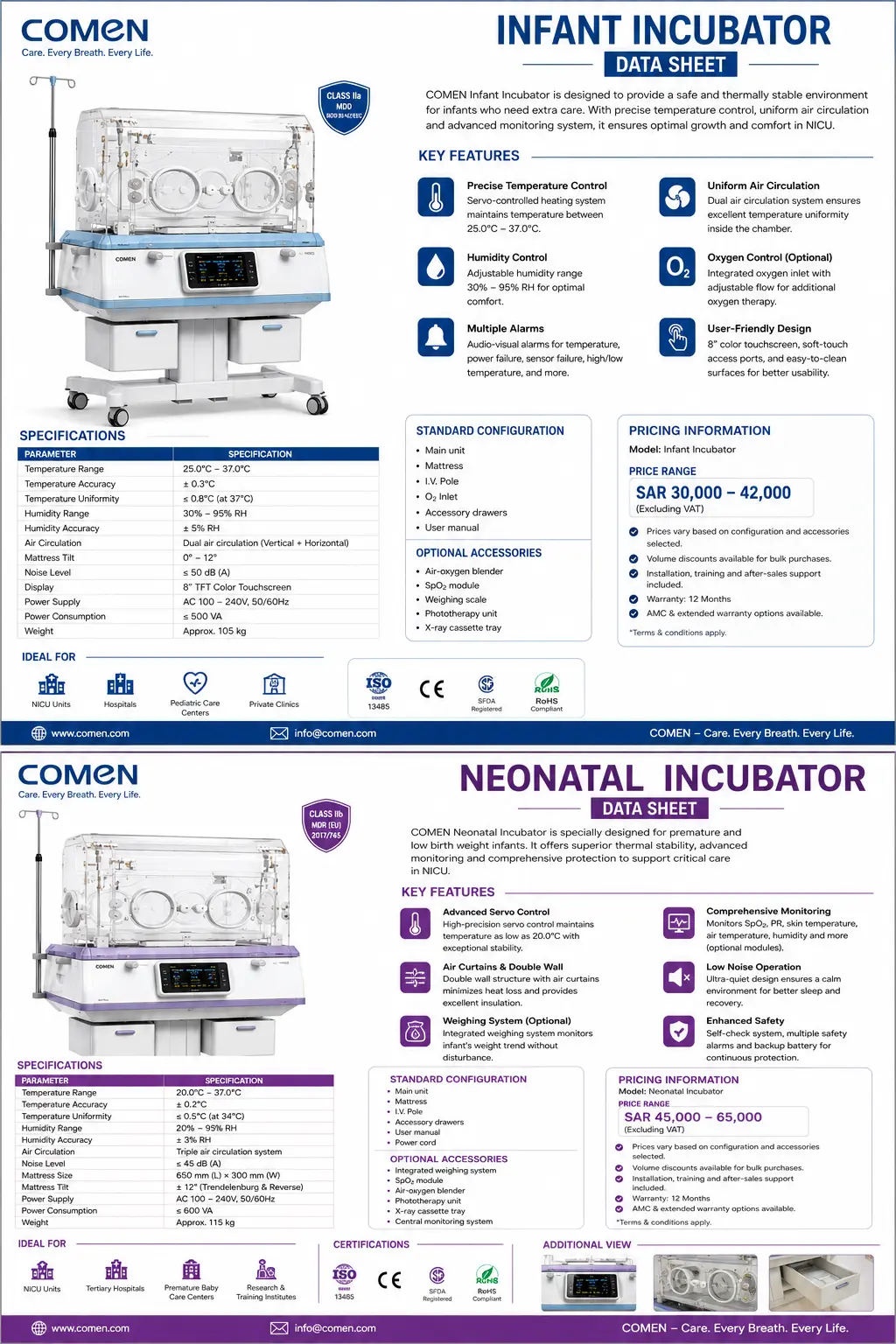
A Level III NICU managing a high volume of premature births typically shortlists neonatal incubators capable of maintaining stable servo-controlled air or skin temperature, closed-loop humidity regulation, and integrated oxygen monitoring. Procurement teams usually prioritize double-wall incubator chassis with phototherapy compatibility, configurable alarm thresholds, and ISO 13485-certified manufacturing before requesting quotations.
For patients below 1.5 kg, biomedical engineers generally look for incubators with dual servo-control modes (air and skin), humidity ranges up to 95% RH, noise levels kept below 60 dB inside the hood, and an X-ray tray built into the mattress platform so radiographs can be taken without repositioning the infant.
Pricing depends heavily on brand, servo-control sophistication, phototherapy integration and the service package attached. As a general planning reference (not a quotation), standard single-servo NICU incubators typically start in the SAR 40,000-70,000 range, while advanced dual-servo units with integrated phototherapy, humidity control and monitoring modules commonly range from SAR 70,000-150,000+. Request an itemized quotation to confirm exact pricing, since import duties and warranty terms affect the final figure.
Suppliers such as Attieh Medico and Salehiya Healthcare maintain dedicated NICU equipment lines with in-Kingdom biomedical engineering teams for installation, calibration and after-sales service, which shortens turnaround on service tickets compared with importing support from outside Saudi Arabia.
neonatal-Incubator-datasheet-with-technical-specifications-in-ksa
A regional referral hospital coordinating neonatal transfers from smaller government hospitals to a Level III NICU needs a transport incubator that holds temperature and humidity stability through vehicle transitions, ambulance-to-aircraft handoffs, and extended transit times across the Kingdom's larger provinces. Procurement teams weigh battery runtime, mounting compatibility with ambulance gurneys, and ventilator integration ahead of price.
Transport incubators are frequently purchased alongside spare battery packs and a dedicated trolley, since departments running frequent inter-hospital transfers keep a second battery charging while one unit is in the field. A vehicle mounting bracket compatible with the receiving hospital's ambulance fleet should be confirmed before ordering.
Transport incubators generally range from SAR 60,000-120,000 for standard configurations, rising to SAR 120,000-180,000+ for units with integrated ventilator mounting and dual-battery aviation-compliant configurations. Confirm exact figures with a supplier quotation.
Suppliers covering the Eastern Province and Qassim, such as Bloom Medical Company, can typically support both purchase and calibration for ambulance fleets operating outside the major cities.
A delivery suite handling routine and high-risk deliveries needs immediate open access to the newborn during the first minutes of stabilization, which is why open (radiant) warmers remain standard equipment in labor and delivery rooms even where closed incubators are also available in the adjoining NICU. Procurement priorities center on radiant heater response time, overhead accessibility for resuscitation, and integrated timers for Apgar scoring.
Hybrid units that combine an open warmer bassinet with a convertible closed-incubator hood are increasingly requested by mid-sized hospitals that want to stabilize and then transition a neonate without a full equipment change, reducing capital expenditure on delivery-room equipment.
Standard open warmers typically range from SAR 15,000-35,000, while hybrid open-warmer/incubator convertible units range from SAR 45,000-80,000+ depending on brand and monitoring integration.
A clinical or pharmaceutical testing laboratory running cell culture, microbiology, or stability testing protocols needs uniform temperature distribution across the chamber rather than the servo-control precision required for patient-facing incubators. Laboratory managers typically prioritize chamber uniformity, CO2 control accuracy for cell culture work, and HEPA filtration for contamination control over the clinical monitoring features found in NICU incubators.
Basic benchtop laboratory incubators typically start around SAR 8,000-20,000, while CO2-controlled cell culture incubators with HEPA filtration and data logging range from SAR 20,000-45,000+.
Bloom Medical Company and Saudi Medical Gate both distribute laboratory and scientific equipment lines suited to hospital and university laboratories, and can typically bundle laboratory incubators with related consumables and spare parts in a single procurement cycle.
An IVF laboratory culturing embryos from fertilization through blastocyst stage needs incubators that hold extremely tight temperature, humidity, CO2 and, in many current protocols, O2 tolerances, since even small fluctuations can affect embryo development outcomes. Fertility clinics generally evaluate benchtop multi-chamber incubators or time-lapse incubation systems ahead of larger single-chamber units, since individual chamber access limits disturbance to other patients' embryos.
Standard tri-gas benchtop IVF incubators typically range from SAR 60,000-120,000, while multi-chamber time-lapse incubation systems commonly range from SAR 150,000-300,000+ depending on the number of individual chambers and imaging integration.
Attieh Medico's product portfolio covers IVF and laboratory equipment lines, making it a reasonable first point of contact for fertility centers sourcing both the incubator and related laboratory consumables in one procurement process.
Use the comparison below as a quick reference when scoping which incubator category applies to your department before requesting quotations.
| Department | Incubator Type | Top Priority | Indicative Range (SAR) |
|---|---|---|---|
| Level II/III NICU | Servo-controlled closed incubator | Dual servo control, humidity range | 40,000-150,000+ |
| Delivery Room | Open/radiant warmer | Heater response time, open access | 15,000-80,000 |
| Ambulance / Air Transfer | Transport incubator | Battery backup, ventilator mounting | 60,000-180,000+ |
| Diagnostic / Microbiology Lab | Laboratory incubator | Chamber uniformity, CO2 control | 8,000-45,000+ |
| IVF / Fertility Lab | Multi-chamber / time-lapse incubator | Chamber isolation, tri-gas control | 60,000-300,000+ |
Ranges are indicative planning estimates only and vary by brand, configuration and service contract. Request an itemized supplier quotation for exact pricing.
Procurement teams rarely compare incubators on price alone. The specifications below are grouped by function and are the ones that most often determine which model gets shortlisted for a tender.
| Specification | Why Buyers Compare It |
|---|---|
| Temperature Range & Accuracy | Determines suitability for extremely low birth weight infants versus general neonatal care; tighter accuracy reduces the risk of thermal stress. |
| Servo Temperature Control | Air-mode vs. skin-mode control affects how the incubator responds to an individual infant's condition rather than just ambient air. |
| Humidity Control | Higher achievable humidity (up to 95% RH) is critical for premature infants with immature skin barriers. |
| CO2 Control | Relevant for laboratory and IVF incubators where gas composition affects cell or embryo viability. |
| Air Circulation | Uniform airflow prevents localized hot/cold spots inside the chamber or hood. |
| Specification | Why Buyers Compare It |
|---|---|
| Oxygen Monitoring | Integrated monitoring reduces the number of standalone devices attached to the incubator and simplifies alarm management. |
| Alarm System | Configurable, redundant alarms are typically a mandatory requirement for tender compliance in Level II/III NICUs. |
| Noise Level | Lower internal noise levels support neonatal neurodevelopment protocols increasingly required in NICU design standards. |
| Battery Backup | Essential for transport units and for maintaining stability during power interruptions or intra-hospital moves. |
| Skin Temperature Probe | Enables skin-servo mode and continuous individualized temperature monitoring. |
| Specification | Why Buyers Compare It |
|---|---|
| Phototherapy Compatibility | Integrated mounts avoid additional freestanding equipment cluttering the bassinet area. |
| X-ray Tray | Allows radiographs without moving a critical patient out of the incubator. |
| Weight Capacity & Mattress Size | Confirms the unit accommodates the patient population your department treats, including larger neonates. |
| Display & Controller | Touchscreen vs. button interface affects staff training time and ease of use during emergencies. |
| Construction Material | Medical-grade acrylic and powder-coated steel affect durability, cleanability and infection control. |
| Internal Dimensions | Affects staff access for procedures and compatibility with accessories such as monitors and IV poles. |
| Power Supply & Consumption | Confirms electrical compatibility with facility infrastructure and ongoing operating cost. |
| Certification | Relevance |
|---|---|
| SFDA Marketing Authorization | Mandatory for any medical device marketed or operated in the Kingdom. |
| ISO 13485 | Confirms the manufacturer's quality management system meets international medical device standards. |
| IEC 60601 | Electrical safety standard for medical electrical equipment, typically required for tender compliance. |
| CE Marking | Indicates conformity with EU medical device regulations, commonly referenced alongside SFDA approval. |
Hospitals rarely select an incubator brand on specification sheets alone. Local parts availability, calibration turnaround, and warranty terms usually weigh as heavily as the headline features. The manufacturers below are among the most commonly specified brands in Saudi hospital tenders.
A leading manufacturer of neonatal thermoregulation equipment, known for advanced servo-control systems in both incubators and open care warmers. View Dräger's neonatal incubator range.
Manufacturer of the Giraffe and Panda incubator and warmer lines, widely specified in NICUs for their integrated monitoring and transport-compatible platforms. View GE HealthCare's neonatal solutions.
A pioneer of the modern infant incubator with the largest market share in Japan, offering a broad product line spanning incubators, warmers and phototherapy units. View Atom Medical's product range.
A long-established neonatal equipment manufacturer distributing incubators to more than 100 countries, often positioned as a cost-competitive alternative to European and North American brands. View Fanem's incubator range.
A Korean manufacturer supplying infant incubators, warmers and phototherapy units with a focus on accessible, dependable equipment for both established and resource-limited markets. View Bistos's infant incubator range.
Before comparing brands, procurement teams typically confirm:
Accessories are rarely an afterthought on a procurement checklist — most are ordered in the same purchase cycle as the incubator itself.
| Accessory | Purchased For |
|---|---|
| Phototherapy Units | NICU incubators and open warmers treating neonatal jaundice |
| Patient Monitors | Continuous vital-sign tracking alongside incubator monitoring |
| Oxygen Sensors | Incubators without integrated O2 monitoring modules |
| Skin Temperature Probes | Servo-controlled units and spare probes for high-usage departments |
| Spare Mattresses | Infection control turnover between patients |
| Trolleys | Laboratory incubators and mobile open warmers |
| Spare Battery Systems | Transport incubators running frequent inter-hospital transfers |
| Humidity Modules | Upgrading existing incubators without built-in high-humidity control |
| CO2 Modules | Laboratory and IVF incubators requiring gas-controlled culture conditions |
| HEPA Filters | Laboratory incubators and infection-sensitive NICU environments |
| Spare Parts Kits | Biomedical engineering departments maintaining service continuity between supplier visits |
Delivery time is one of the most common questions procurement teams raise before issuing a purchase order, and it varies significantly based on whether the unit is held in local stock or manufactured to order.
Confirm exact delivery timelines with each supplier at quotation stage, since customs clearance, SFDA registration status of the specific model, and installation scheduling can all shift the timeline.
Before contacting suppliers, confirm the following details so quotations can be compared accurately:
Which incubator is suitable for premature babies below 1.5 kg?
Dual servo-control (air/skin) incubators with humidity control up to 90-95% RH, integrated phototherapy mounts, and X-ray trays are the standard choice for extremely low birth weight infants.
Which incubator supports humidity and oxygen monitoring together?
Most current-generation NICU incubators integrate both humidity control and oxygen monitoring into a single control panel; laboratory and transport incubators vary, so confirm this at the specification stage.
Can transport incubators connect with ventilators?
Most transport incubators are designed with an integrated trolley that accommodates a portable ventilator, oxygen cylinder and syringe pump alongside the incubator unit; confirm mounting compatibility with your specific ventilator model.
Which certifications are typically required in Saudi hospitals?
Government and most private hospital tenders require SFDA marketing authorization for the device, along with ISO 13485 (quality management), IEC 60601 (electrical safety), and CE marking from the manufacturer.
How often should hospital incubators be calibrated?
Calibration frequency depends on manufacturer guidelines and hospital biomedical policy, but most facilities schedule calibration checks at least annually, with more frequent checks for high-usage NICU units.
Which accessories should hospitals purchase together with an incubator?
Phototherapy units, skin temperature probes, spare mattresses, and (for transport units) spare battery packs are the accessories most commonly purchased in the same procurement cycle.
Can suppliers provide installation and staff training?
Established medical equipment suppliers in Saudi Arabia generally include installation, commissioning, and initial staff training as part of the supply contract; confirm this is itemized in the quotation.
Which incubator is suitable for IVF laboratories?
Multi-chamber benchtop incubators with individual chamber isolation and tri-gas control are the standard choice for IVF laboratories running embryo culture protocols.
What warranty should procurement teams expect?
Warranty terms vary by brand and supplier; confirm what is covered (parts, labor, calibration visits) and whether an annual service contract is available once the manufacturer warranty expires.
How much does a medical incubator cost in Saudi Arabia?
Pricing depends on the incubator category, brand and configuration. As a general planning reference, NICU incubators range from roughly SAR 40,000 to SAR 150,000+, while laboratory incubators start lower, around SAR 8,000. Request an itemized quotation for exact figures.
How long does delivery take after placing an order?
In-stock models typically deliver within 2-4 weeks; special-order or imported configurations generally take 6-12 weeks. Confirm the exact timeline with your chosen supplier before finalizing the order.
All medical devices and incubators marketed or operated in the Kingdom must hold a valid Medical Device Marketing Authorization (MDMA) from the Saudi Food and Drug Authority (SFDA). Confirm current registration status directly with the SFDA or the supplier before finalizing a purchase order. Pricing figures throughout this page are indicative planning estimates only, not fixed quotations; request an itemized quote from the supplier for exact costs.

 0
0